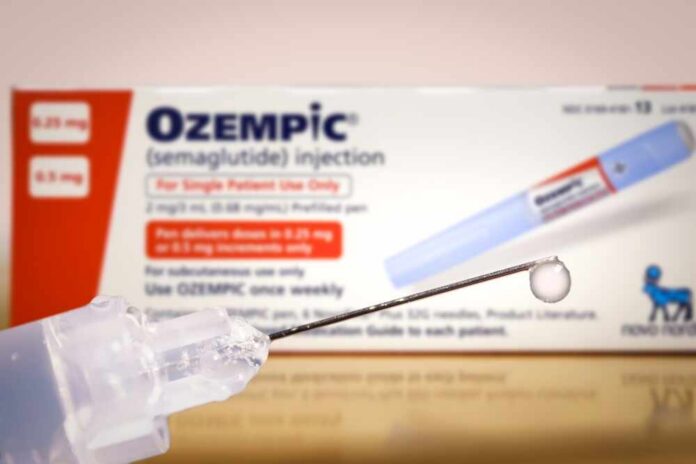
A new economic study says popular GLP-1 drugs like Ozempic and Wegovy are not just shrinking waistlines—they are also shrinking long-term sick leave by about 17 percent, with real money on the line for workers, employers, and taxpayers.
Story Snapshot
- Researchers found GLP-1 users took about 17% less long-term sick leave than similar workers who did not use the drugs.
- The study links this drop to lower use of emergency care, heart drugs, and sickness benefits, adding up to hundreds of dollars saved per worker each year.
- Health-related productivity costs often outweigh medical costs, so fewer sick days can matter more than a smaller health plan bill.
- Employers now face a hard question: Are expensive GLP-1 drugs a smart investment in a stronger, more present workforce?
Researchers track sick leave in the real world, not in a lab
Researchers from the University of Copenhagen, the University of Chicago, Duke University, and the Rockwool Foundation dug into nationwide Danish health and employment records to answer a simple question: Do workers on GLP-1 treatment end up taking less serious sick leave than similar workers who are not yet on the drugs?
They focused on “long-term” sick leave, meaning medically certified absences that last more than 30 days, not just a flu day or a long weekend.
GLP-1 drugs linked to 17% drop in worker sick leave, new economic study finds. https://t.co/h3Jjwf2KAI
— CBS News (@CBSNews) July 22, 2026
The team compared employed adults who started GLP-1 drugs with similar patients who would start the same drugs later. Because both groups were on track for the same treatment, this “staggered start” design helps limit simple cherry-picking, like only treating the healthiest people.
Over four years after treatment began, the GLP-1 group consistently took fewer long sick-leave spells than the later-start group.
Seventeen percent fewer long absences and hundreds of dollars saved
The headline number comes straight from the working paper: GLP-1 treatment cut long-term sickness leave by 0.95 percentage point, which is a 17.3 percent drop compared with a pre-treatment average of 5.5 percent.
Put less dry, that means for every 100 workers at that risk level, about 17 out of 100 long sick-leave events disappear once GLP-1s are in the mix, over a four-year span.
This effect grew over time. The reduction in long-term sick leave was about 0.8 percentage point in the first two years after starting treatment, rising to roughly 1.1 percentage points in years three and four. Because the Danish system tracks both earnings and benefits, the researchers could translate fewer long absences into money.
They estimate total fiscal savings of about 1.3 to 1.5 percent of annual labor income per treated employed worker, or around 866 dollars a year at current exchange rates.
Why fewer sick days matter more than the health plan bill
For employers, the cost of illness is not just what the health plan pays. A large multi-employer study in the United States found that health-related productivity costs, such as missed work and reduced performance on the job, run about 2.3 times higher than direct medical and pharmacy costs.
That means one dollar “saved” on absenteeism and presenteeism can be worth more than one dollar shaved off the insurance premium.
Other research has shown that chronic conditions like obesity, depression, arthritis, and back pain drive a big share of productivity loss. Workers with several chronic conditions miss more days, and their lost output climbs sharply as conditions stack up.
GLP-1 drugs directly target two of the biggest drivers—type 2 diabetes and obesity—so it makes sense that better control here could ripple into fewer long stretches away from work.
More than weight loss: health improvements that keep people on the job
The same Danish study found that GLP-1 users needed fewer emergency department visits and used fewer cardiovascular medications than similar non-users, and they drew less on long-term sickness benefits.
These downstream changes line up with a growing medical literature showing that GLP-1 drugs reduce serious problems like stroke, heart failure, diabetic kidney disease, and even sleep apnea. Fewer crises and complications usually mean fewer long medically certified breaks from work.
Consulting firms studying employer data are seeing related patterns. One analysis found that diabetes patients using GLP-1 therapy saw medical costs fall 6 to 9 percent after about 30 months, compared with similar patients not using the drugs.
People using GLP-1s for weight loss saw medical costs 3 to 7 percent lower within 18 months. That is straight-line logic: fewer severe health events, lower medical costs, and fewer days when people simply cannot work.
High drug prices, side effects, and what conservative common sense says
The catch is cost. GLP-1 drugs are expensive, and no federal law requires employers to cover them for obesity treatment. Employers that do offer coverage have to balance high monthly drug bills against the promise of fewer hospital stays, fewer disability claims, and now, fewer long sick leaves.
Side effects are another real-world issue. Common problems include nausea, diarrhea, constipation, and fatigue, and serious though less common risks include pancreatitis and possible gallbladder or kidney issues.
Workers with strong side effects may even need sick time early on. But when the drugs are carefully prescribed and monitored, most side effects fade, while gains in metabolic health and weight can last. For many employers, that trade looks like a classic short-term cost for long-term gain.
Sources:
cbsnews.com, meltemdaysal.com, healthandme.com, pmc.ncbi.nlm.nih.gov, workcare.com, hrp.net, fisherphillips.com, uspm.marketing.s3.amazonaws.com, 8926463.fs1.hubspotusercontent-na1.net