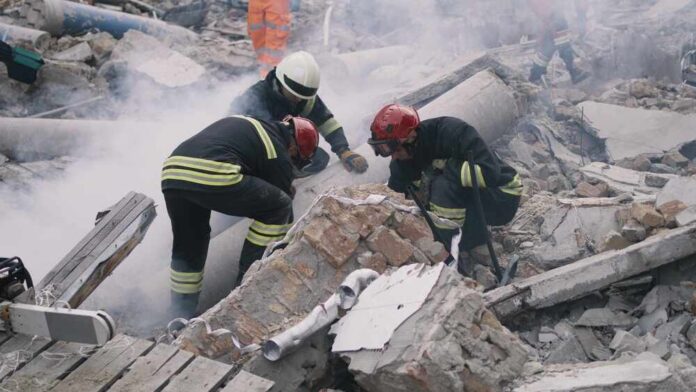
The most striking fact is that a single violent quake turned an ordinary shopping trip and factory shift into a fight for survival, with rescuers racing through a shattered mall and a broken paper plant to keep Japan’s death toll from climbing beyond 18.
Story Snapshot
- A 7.1-magnitude earthquake hit Kumamoto Prefecture, killing at least 18 people and injuring dozens.
- Part of Aeon Mall in Kashima Town collapsed after an explosion, trapping shoppers and workers as rescuers searched the rubble.
- A chimney collapse at a paper factory in nearby Yatsushiro killed five more people and left others feared trapped.
- Unclear missing-person counts and fast-changing reports show how chaotic disaster information can be in real time.
Quake hits busy region and turns daily life into disaster
A powerful 7.1-magnitude earthquake struck Japan’s southern Kumamoto Prefecture late on a Tuesday afternoon, right in the middle of normal daily routines. The Japan Meteorological Agency reported intense shaking across Kyushu, strong enough to knock out power, halt rail service, and trigger tsunami warnings along the coast.
People were shopping, working, or commuting when the ground moved, which explains why casualty numbers rose quickly as officials began to grasp what had happened.
New police bodycam footage shows the devastation inside the Aeon Mall in Kashima after a powerful 6.8-magnitude earthquake struck Japan's Kumamoto region.
At least 13 people were killed and around 50 injured.
Four people remain missing after part of the shopping centre… pic.twitter.com/0OsjLKFVEF
— Channel 4 News (@Channel4News) July 29, 2026
Local reports describe scenes of broken roads, toppled buildings, and emergency sirens cutting through the dust and smoke. Earthquake seismologists pointed out that while the magnitude itself was not extreme, the key factor was how shallow and close to population centers the quake was, which sharply amplified the damage.
That combination—ordinary weekday timing, a shallow hypocenter, and dense infrastructure—meant ordinary spaces like malls and factories suddenly became high-risk zones instead of shelter.
Aeon Mall collapse shows the danger of crowded modern spaces
In Kashima Town, Aeon Mall went from safe indoor space to disaster site within minutes. Multiple outlets report an explosion at the mall shortly after the quake, followed by the collapse of part of the building, including its second floor, where many people had been shopping.
Video and eyewitness accounts show severe structural failure, smoke, and twisted metal framing, with emergency services saying people were trapped inside and several feared dead.
Rescuers hauled survivors from the damaged sections of the mall through the night, using ladders, cutting gear, and dogs as they tried to reach pockets where victims might still be alive.
Officials spoke of 20 to 30 workers unaccounted for at one point, and later counts noted at least four confirmed deaths tied directly to the mall site. This swing in numbers is common in fast disasters, but for families and viewers, every shift feels like another shock layered on the physical quake.
Paper factory collapse adds to the toll and shows industrial risk
The Aeon Mall was not the only place turned deadly by the quake. In nearby Yatsushiro, a large chimney at a Nippon Paper Industries factory collapsed, crushing workers and burying part of the plant under heavy concrete and steel. Local authorities confirmed that five people died in the factory collapse and that seven others were pulled alive from the debris by rescue teams.
Officials said four more people were still believed trapped at the factory site as crews worked through unstable rubble and aftershocks. Industrial structures often look solid, but tall chimneys and older heavy installations can fail in sharp, sideways shaking.
When that happens, the workers inside do not have the luxury of clear escape routes or open plazas—many are surrounded by machines, pipes, and narrow walkways, which makes collapse more lethal and rescue far harder.
Racing the clock amid confusion and changing numbers
Across the region, soldiers, firefighters, and police dug through collapsed homes and commercial buildings as the official death toll climbed to at least 18 and injuries passed 60.
Prime Minister Sanae Takaichi said rescue workers were still searching for missing people at both the damaged mall and the factory, while also watching for landslides and secondary hazards. Each new body found or survivor pulled out changed the numbers, and reporters updated totals almost by the hour.
A powerful 6.8 to 7.1 magnitude earthquake struck Japan's southern Kumamoto prefecture on Kyushu island on July 28, 2026. The shallow inland disaster caused at least 13 deaths, triggered a partial collapse and explosion at a shopping mall, and knocked down a factory chimney,… pic.twitter.com/JaIsFibLBv
— mia khalifa (@xgrowthtip) July 29, 2026
This kind of shifting information frustrates many viewers, especially in an online environment that rewards bold, fast claims. But it fits a long pattern in major disasters: initial counts of “many trapped” and “dozens missing” gradually harden into confirmed fatalities as rosters are checked and duplicate reports are removed.
The lesson is clear: trust transparent facts on who is dead, who is missing, and what is proven about causes, instead of chasing the most dramatic rumor.
Sources:
youtube.com, scmp.com, english.elpais.com, newscord.org, rt.com, theguardian.com, people.com, reuters.com