
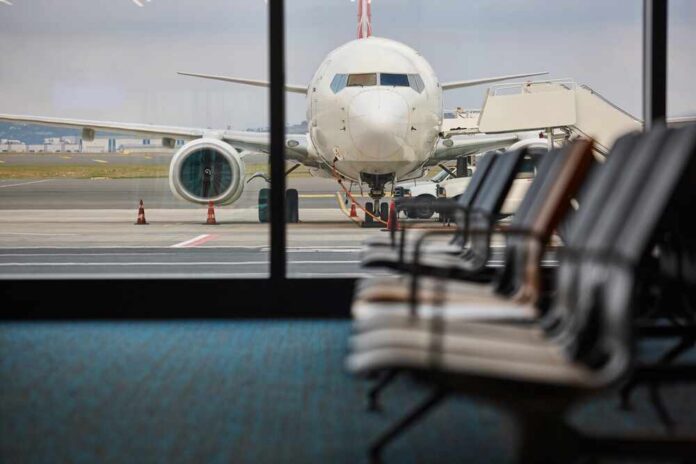
Dallas-Fort Worth International Airport is adding foot-washing sinks to two of its restrooms, and the news has turned into a nationwide fight over religion, tax dollars, and what airports owe their travelers.
Story Snapshot
- Texas regulators show a project registered July 31 to add ablution stations inside existing Terminal D restrooms.
- The plan adds one station to the men’s restroom and one to the women’s restroom on the concourse level.
- Reports put the cost near $300,000, with work set to finish by the end of 2026.
- DFW already runs ablution stations next to its Terminal D interfaith chapel, a setup in place since 2019.
What The Filing Actually Says
The Texas Department of Licensing and Regulation logged a new project on July 31. It describes adding ablution stations, sometimes called wudu stations, to restrooms already open at Terminal D’s concourse level.
The filing names one men’s station and one women’s station, both fitted into current restroom space rather than a new building or wing. Fox News first reported the filing details, and Just the News confirmed the same regulatory language days later.
Islamic foot-washing stations are coming to Dallas-Fort Worth International Airport.
The new Wudu stations will be installed in men's and women's restrooms in Terminal D, giving Muslim travelers a dedicated place to perform ritual washing before prayer.
Officials point to… pic.twitter.com/iA4iDgzjtl
— Fox News (@FoxNews) August 13, 2026
Wudu is the Islamic washing ritual Muslims perform before prayer. It involves cleaning hands, face, arms, and feet, usually at a low sink built for that purpose.
Posts circulating online put the project cost at roughly $300,000, with completion targeted for late 2026. That price and timeline have not appeared in a public DFW statement, so travelers are relying on the regulatory filing and secondary reporting for now.
This Is Not DFW’s First Ablution Project
DFW is not building religious infrastructure from scratch. The airport reopened its Terminal D interfaith chapel in 2019 and added two ablution stations right next to it for ritual washing, according to the airport’s own newsroom release.
That chapel is one of five interfaith spaces spread across DFW’s terminals, each meant to serve travelers of different faiths passing through one of the country’s busiest airports.
Airports nationwide have quietly added similar fixtures for years. A 2008 report on a different major airport described low sinks built into a terminal restroom specifically to make ritual washing easier for Muslim travelers and staff.
Seen against that backdrop, DFW’s new restroom project looks like an extension of existing practice rather than something wholly new for American air travel.
Why This Story Hit A Nerve
Social media turned a restroom retrofit into a flashpoint within hours. Commentators framed the project as proof of cultural change happening without public input, with one widely shared post calling it a sign Americans are “being conquered” through quiet policy shifts.
Others asked pointed questions about whether other faiths get similar accommodations at public expense, a fair question taxpayers deserve answered plainly by airport officials.
Bathrooms at Dallas-Fort Worth International Airport to have Islamic ritual foot wash stations https://t.co/RpZUDHRcNe
— John Solomon (@jsolomonReports) August 13, 2026
That reaction fits a familiar script. NPR covered nearly the same argument back in 2007, when the University of Michigan built foot baths for Muslim students.
School officials said the goal was to prevent slippery floors and accommodate prayer schedules, while critics said the project singled out one religion for special treatment funded by public money.
The wording changes, but the core disagreement, over fairness and transparency in public spending, hasn’t moved much in nearly two decades.
What Taxpayers Still Deserve To Know
Nobody disputes that the Texas filing exists or that it names Terminal D restrooms. What’s missing is a direct, on-record explanation from DFW itself about why now, who’s paying, and whether other faith groups requested similar upgrades and were denied.
Silence from the airport lets speculation fill the gap, and that silence is a choice DFW can fix with one clear public statement.
Airports are public infrastructure, funded partly by ticket fees and government dollars, and travelers have every right to ask how that money gets spent.
A $300,000 line item for two sinks, tucked into a regulatory database instead of announced openly, is exactly the kind of thing that breeds distrust even when the underlying project is legal and unremarkable. Government transparency isn’t a courtesy. It’s the baseline taxpayers should expect every time.
Sources:
foxnews.com, justthenews.com, x.com, dfwairport.com, cair.com, npr.org