
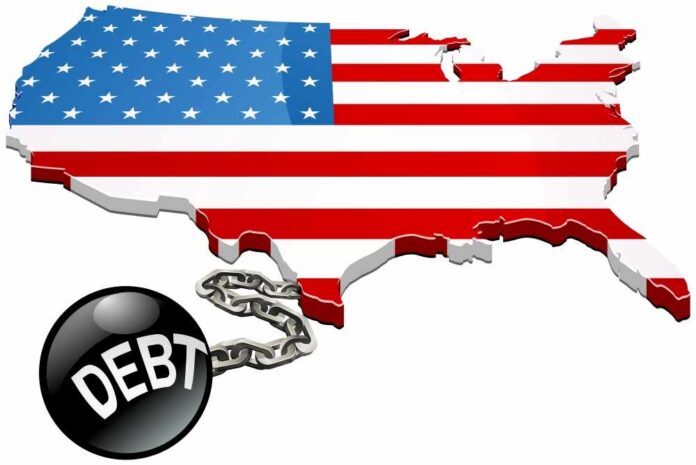
America’s consumer boom is being propped up by record debt, shrinking savings, and a growing risk that one shock turns a soft slowdown into a hard stop.
Story Snapshot
- U.S. household debt has climbed to a record high near $19 trillion, even as savings plunge.
- Societe Generale warns that a growing share of growth now hangs on borrowed money and market gains, not rising real wages.
- Delinquencies are rising fastest among stretched, lower-income borrowers, while headline ratios still look “fine.”
- History shows high household debt does not always cause a crash, but it makes any future shock hit much harder.
Why a Record Debt Pile Feels Different This Time
Federal Reserve data show U.S. household debt now stands around $18.8 trillion, an all‑time high in dollar terms.[17] That number alone does not doom the economy, but it tells you how Americans are getting by: more swiping, more signing, less saving.
Total liabilities hit almost $19.9 trillion at the end of the first quarter in one Societe Generale analysis, while the personal saving rate hovered near about 2%.[1][4] That is thin protection if anything goes wrong.
'RUNNING OFF THE CLIFF': AN EXPLOSION OF HOUSEHOLD DEBT HAS PUT THE US ECONOMY IN A TOUGH SPOT
In a recent note to clients, the European Bank flagged a concerning trend that's taken hold in the US in recent years: the rise in household debt and the concurrent decline in… pic.twitter.com/o3P26zmtpM
— FXHedge (@Fxhedgers) June 21, 2026
Business Insider and others picked up Societe Generale’s warning that Americans are “running off the cliff” because they borrow more while saving less.[4][6]
The bank’s strategist Albert Edwards highlights what he calls the “wealth effect” at work: when stocks and home values soar, people feel richer and borrow against that paper wealth instead of building cash buffers.[4] That might look smart while markets rise, but it leaves households exposed when asset prices stumble.
Debt-Fueled Growth Is Getting Less Bang for the Buck
Societe Generale also points to a troubling metric: how much new debt it now takes to squeeze out one unit of growth. Research cited in their note suggests the “credit intensity” of gross domestic product has climbed to its worst level in at least 70 years.[1]
In plain English, the economy needs more and more borrowing to get the same growth. That pattern fits longer‑run work from the Bank for International Settlements, which finds household debt supports growth in the short run but drags it down over time once it gets too high.[12]
That tradeoff matters for anyone who values stable, broad‑based prosperity over short sugar highs. In the near term, easy credit props up consumption, helps companies book profits, and keeps unemployment low. But as the debt stock rises, more income goes to interest and principal instead of goods, services, and investment.
Studies show that as household debt ratios cross certain thresholds, future growth tends to slow and recessions become more likely.[12][13] You do not need a Ph.D. to see the common‑sense problem: if everyone is already stretched, they cannot keep borrowing forever.
Who Is Actually at Risk: Not Every Borrower, but the Fragile Edge
Federal Reserve stability reports stress that, on average, household debt payments as a share of income remain near 20‑year lows.[19] Most mortgage borrowers locked in fixed rates when money was cheap, so higher interest rates have not crushed the typical middle‑class family—yet.[19]
That is the counter‑argument to the “cliff” story: balance sheets look healthier than they did in 2007, and the overall debt‑to‑gross‑domestic‑product ratio is lower.[19] That is true, but it hides bruises under the averages.
New York Federal Reserve data show delinquencies are climbing, especially on credit cards and auto loans, and are now at or near multi‑year highs.[18] Advocacy groups that track the same data describe a “perfect storm” for many families: higher prices, thin savings, and multiple debts going bad at once.[18]
Other research finds that the bottom income groups carry the highest debt‑to‑income ratios and rely most on borrowing to keep up their standard of living.[11][20] From a common‑sense view, that is a problem of household discipline and policy failure at the bottom, not a blanket crisis for every American.
Why This Matters for Markets, Politics, and Policy
High household debt with weak savings changes how the whole system reacts to shocks. A modest rise in unemployment, a stock‑market correction, or another jump in interest rates hits harder when many families have no cushion and carry variable‑rate or short‑term debts.
Research from Brookings shows that as debt service burdens rise, output and consumption fall for years afterward, even without a banking panic.[13] That is the slow‑motion version of “running off the cliff”—no explosion, just a long slide in living standards.
So how should a prudent country respond? First, stop pretending debt is either all good or all bad. Credit helps families buy homes, start businesses, and smooth life shocks. But when Washington chases every slowdown with more cheap credit and transfer programs, it encourages a culture of living beyond means instead of producing and saving.
Research suggests that once household debt rises too far above income, gains from extra borrowing fade and the risks pile up.[12][20] That should push policymakers toward growth based on productivity and work, not leverage.
Sources:
[1] Web – ‘Running off the cliff’: An explosion of household debt has put the US …
[4] Web – [PDF] BOX 3.1 The costs of hidden debt – The World Bank
[6] Web – Monthly House Views – On a roll ! – June 2026
[11] Web – Private Credit Outlook 2026 – With Intelligence
[12] Web – Keeping Up with Household Debt in the US
[13] Web – [PDF] The real effects of household debt in the short and long run
[17] Web – U.S. Household Debt Surges $740B In 2025
[18] Web – Household Debt and Credit Report
[19] Web – American Families Hit Record Levels of Financial Distress as …
[20] Web – The Fed – 2. Borrowing by Businesses and Households