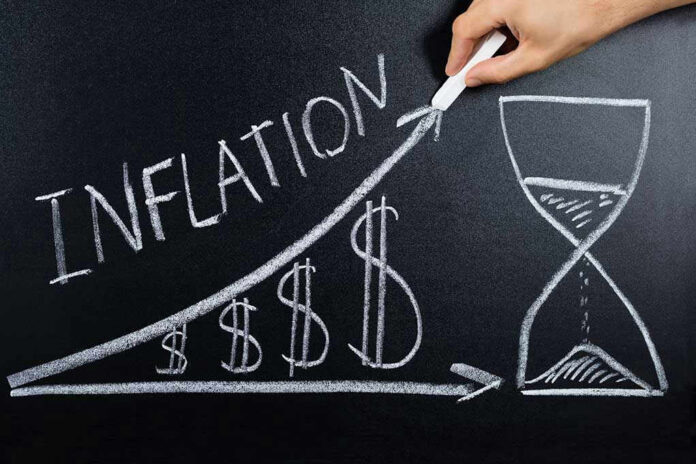
JPMorgan Chase CEO Jamie Dimon warns that the ongoing US-Iran war could trigger higher inflation and interest rates, threatening American families already crushed by years of economic mismanagement and soaring costs.
Story Snapshot
- Jamie Dimon cautions that Iran war disruptions could spike inflation and keep interest rates elevated longer than expected
- Goldman Sachs projects headline inflation could reach 4.9% in severe scenarios as oil prices surge past $140 per barrel
- American households face gasoline prices up $1 per gallon, with food inflation potentially hitting 12% if conflict persists
- Federal Reserve may delay rate cuts as recession odds climb to 30%, leaving families trapped in a high-cost environment
Wall Street Sounds Alarm on War’s Economic Toll
Jamie Dimon issued stark warnings about the economic consequences of the US-Iran war, highlighting risks of persistent inflation and elevated interest rates that could derail hopes for financial relief.
The JPMorgan Chase CEO’s assessment aligns with Goldman Sachs projections showing headline inflation potentially reaching 3.1% by December 2026 in baseline scenarios, with worst-case peaks of 4.9%.
The war, now entering its second month, has already disrupted oil flows through the Strait of Hormuz, sending Brent crude to $105 per barrel in March.
This represents yet another crisis American families must endure after years of inflationary pain.
Energy Shock Compounds Inflation Crisis
Oil price disruptions drive the core inflationary threat, with Goldman Sachs economists estimating that every 10% increase in oil prices adds 0.2% points to inflation.
Current projections show Brent crude potentially spiking to $140-160 per barrel in adverse scenarios before settling around $80-115 by year’s end.
Gasoline prices have already jumped $1 per gallon, hitting working families hardest, while fertilizer export constraints threaten to boost food prices by 1.5%.
This energy-driven inflation recalls the devastating impact of the 2022 Ukraine war, which sent food inflation soaring to 19%.
Agricultural economists warn that food inflation could reach 12% if the conflict continues, eroding purchasing power for Americans already stretched thin.
Jamie Dimon says US must 'finish this thing' with Iran to protect global economy https://t.co/kGQWs47xVt
— FOX Business (@FoxBusiness) March 31, 2026
Federal Reserve Trapped Between Inflation and Growth
The Federal Reserve faces an impossible choice as war-driven inflation complicates monetary policy amid already sticky price pressures. Headline inflation stood at 2.8% in January 2026 with core inflation at 3.1%, well above the Fed’s 2% target.
Goldman Sachs maintains baseline expectations for two 25-basis-point rate cuts in September and December 2026, but raised recession odds from 25% to 30%.
The probability the Fed holds rates steady has climbed to 25% as policymakers weigh inflation risks against economic slowdown.
This leaves American families trapped in a high-cost, high-rate environment with diminishing prospects for relief, all while the administration grapples with the domestic fallout of yet another foreign conflict.
American Households Bear the Burden
Working families face compounding economic pressures as energy costs cascade through the economy, squeezing household budgets already strained by years of inflation.
The March 2026 consumer price index registered a 1% monthly increase, the sharpest jump since 2022, driven primarily by transportation and energy costs.
Lower-income households suffer disproportionately as gasoline and food consume larger portions of their budgets.
Asia’s energy-importing nations, including India and Japan, face similar pressures, while Iran’s economy contracts by over 10%.
Goldman Sachs estimates GDP could decline by 0.25-0.4% points if oil prices remain elevated at $100 per barrel, threatening economic growth prospects. This underscores how foreign entanglements directly harm American prosperity and financial security.
Scenarios Paint Grim Economic Outlook
Goldman Sachs modeling reveals three scenarios ranging from manageable to severe economic disruption. The baseline assumes oil settles at $80 per barrel by year’s end with headline inflation reaching 3.1% and core inflation at 2.5%.
The adverse scenario projects oil prices peaking at $140, with fourth-quarter prices around $100, driving headline inflation to 3.6% and spring inflation peaking at 4.6%.
The severely adverse case shows oil hitting $160 and settling at $115, pushing inflation to 4% with peaks near 4.9%.
All scenarios maintain core inflation around 2.5-2.6%, suggesting broad economic stress beyond energy alone.
Recession risks increase across all projections, with supply chain disruptions limited but second-round inflation effects adding 0.1-0.4% points of additional pressure on prices.
Sources:
Iran war could push inflation higher this year, Goldman Sachs says – Fox Business
How Will Iran War Affect Global Economy – Chatham House
Jamie Dimon Warns of Higher Inflation, Interest Rates From Iran War – Wall Street Journal