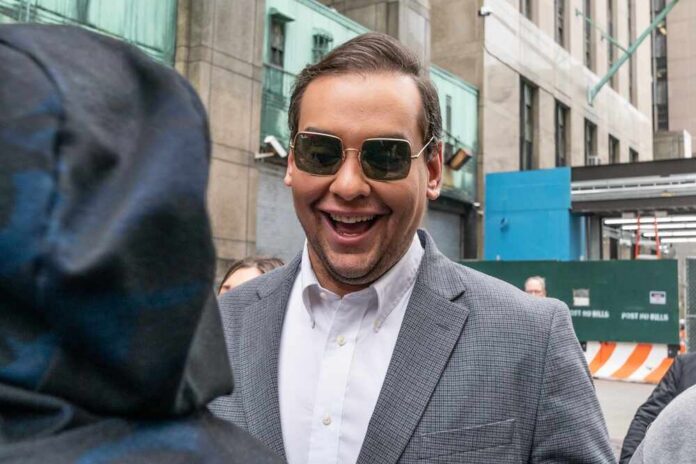
A former congressman’s social media teases allegedly moved a prediction market—and now federal investigators want to know who cashed in.
Story Snapshot
- Federal investigators are probing whether George Santos used nonpublic information to profit on Kalshi, a real-money prediction market [1].
- Market odds reportedly spiked after Santos posted that he would attend the State of the Union and later crashed when he said he was stuck at the airport [1][2].
- Kalshi reportedly flagged the trades, froze the account, and referred the matter to authorities [5].
- Past fraud charges against Santos form the skeptical backdrop, though they are unrelated to Kalshi [4].
How a social post became a trading signal
Investigators at the United States Department of Justice (DOJ) and the Commodity Futures Trading Commission are reportedly examining whether George Santos placed or guided trades on Kalshi tied to his attendance at the State of the Union.
The probe stems from a sequence on the social platform X: Santos said he would attend, the market odds jumped, and after he posted he was stuck at the airport, the odds fell sharply [1][2]. That timeline is the fulcrum of the case.
DOJ probing George Santos over insider trading after ex-rep's alleged Kalshi bets on his own appearance at Trump address: report https://t.co/dr6OttwPcP pic.twitter.com/rcZKVzsko6
— New York Post (@nypost) June 2, 2026
The theory mirrors traditional insider-trading logic adapted to prediction markets. If a person can credibly affect an outcome—or credibly signal it—then trade around that signal, profit can appear indistinguishable from trading on nonpublic information.
The allegation here hinges on whether Santos used or created informational asymmetry, then positioned ahead of the crowd. Authorities reportedly stepped in after the exchange noticed suspicious activity and referred it for review [5]. Markets that trade on yes-or-no events live or die on this information edge.
What regulators must prove, and why it is tricky
Regulators face a hard question: was this savvy speculation in a shallow market or manipulation with foreknowledge? The legal standard rests on material nonpublic information, deception, or a manipulative device. Prediction markets complicate that standard because a public figure’s own conduct can change the odds without any confidential briefing.
A social post can be both a public disclosure and a market-moving act. Investigators will parse timestamps, order logs, account ownership, and links between posts and trades to test intent [1].
The reported referral from Kalshi suggests the platform believed the pattern warranted scrutiny, but a referral is not proof. The case will turn on whether authorities can connect specific trades to Santos or associates, show control over the timing of those posts, and establish that the trader intended to exploit information not yet reflected in price.
Without credible records or admissions, prosecutors often rely on tight timing windows and communications trails. That approach worked in past market-manipulation cases but remains fact-intensive [5].
The defense landscape and credibility headwinds
Santos has publicly denied wrongdoing in various investigations, and reporting here indicates no public, primary-source rebuttal that walks through the trade chronology or releases exchange statements to contradict the alleged activity [1].
A clean defense would foreground account records, device logs, and a neutral explanation for both the posts and any trades. The absence of those counter-documents in public view does not prove guilt; it does, however, leave the narrative anchored to the timeline assembled by reporters and sources.
Context matters for reader judgment. Santos already faces unrelated federal charges for fraud and false statements, which prosecutors filed in the Eastern District of New York in 2023 [4].
Those counts do not make him guilty here, but they reduce the benefit of the doubt that many Americans would otherwise extend. From a common-sense perspective, accountability should be even-handed: if someone gamed a market tied to civic events, charge it; if not, clear it fast and publish the reasoning.
Why this probe matters beyond one headline
Prediction markets promise crowd wisdom, but they also create incentives to manufacture or front-run news. Thin liquidity amplifies the power of a single influencer’s post.
Platforms that want legitimacy must police manipulation with the vigilance of a brokerage and the speed of a newsroom. Kalshi’s reported freeze and referral show a defensive posture that could help the industry mature, provided due process is respected and rules are consistently applied to public figures and anonymous traders alike [5].
DOJ is investigating former congressman George Santos for insider trading on Kalshi | Bobby Allyn, NPR
In February, four months after being released from federal prison, former Republican congressman George Santos took to social media to express his enthusiasm about attending… pic.twitter.com/r1aKb8wn7d
— Owen Gregorian (@OwenGregorian) June 3, 2026
Policy clarity will determine whether these markets complement or corrode civic trust. If regulators show that personal signaling plus trading equals enforcement, public figures will need bright-line rules: disclose, abstain, or accept penalties.
If the evidence falls short, platforms still need tighter guardrails around markets where a participant can influence the outcome. Either way, the takeaway for readers is practical: treat viral proclamations as potential trades dressed up as talk, and remember that in thin markets, timing talks louder than truth [1][2][5].
Sources:
[1] Web – George Santos faces federal probe into insider trading on Kalshi
[2] Web – Trump’s DOJ probing disgraced ex-GOP congressman for insider …
[4] Web – Trump’s DOJ probing disgraced ex-GOP congressman for insider …
[5] Web – Congressman George Santos Charged with Fraud, Money …