
A Russian bomber dropped underwater spy gear near Britain’s flagship carrier.
Story Snapshot
- Russian Bear-F patrol plane flew low and close to HMS Prince of Wales during NATO duty in the High North
- The aircraft dropped sonar buoys used to track submarines and ships near the British carrier strike group
- Two British F-35 jets scrambled from the carrier to intercept and escort the Russian plane away
- The United Kingdom called the Russian maneuvers “unsafe and unprofessional,” fitting a growing pattern of high-risk probing of NATO forces
A Russian bomber pushes the edge near Britain’s flagship carrier
The United Kingdom’s carrier strike group was operating under North Atlantic Treaty Organization command in the Norwegian Sea when a Russian Tu-142 Bear-F maritime patrol aircraft began buzzing the formation. The British Ministry of Defence said the plane repeatedly approached the group at low altitude and came “unnecessarily close” to the aircraft carrier HMS Prince of Wales.
This was not a casual fly-by. It was a large, long-range maritime bomber edging toward the centerpiece of Britain’s fleet during a major NATO operation in the High North.
Russian aircraft intercepted by RAF jets after 'repeatedly approaching' Royal Navy ships in the Arctic https://t.co/1uFbIfsA6w
— Daily Mail (@DailyMail) July 6, 2026
The Russian crew then crossed a line that raised the stakes further. According to the Ministry of Defence, the Bear-F dropped a “large number” of sonobuoys into the water near the carrier. Sonobuoys are disposable underwater sensors that float on the surface and listen for submarines and ships.
They are standard anti-submarine warfare tools, but dropping them close to a carrier strike group turns routine surveillance into targeted tracking. A British spokesperson framed the activity as “unsafe and unprofessional,” signaling that this went beyond normal Cold War-style cat and mouse.
How the British F-35s responded in real time
British forces tried to contact the Russian aircraft using international radio safety channels. The Ministry of Defence says the Bear-F did not respond. That silence matters. When large military planes pass near crowded formations, crews usually talk to avoid accidents. With no response from the Russian side, two United Kingdom F-35 fighter jets launched from HMS Prince of Wales to intercept.
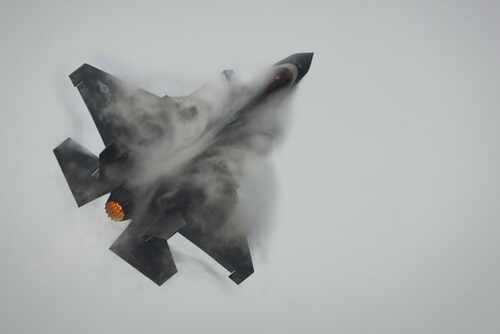
The stealth jets closed in, formed up on the bomber, and then escorted it away from the carrier strike group until it left the area. That is textbook for NATO intercepts, but the setting near a carrier made the risk higher than usual.
The pattern around this incident fits a larger trend. Over the last two decades, Russia has regularly sent bombers and patrol aircraft close to United Kingdom air and sea space, forcing quick reaction launches by British jets.
NATO partners see similar behavior in the Baltic region, where alliance fighters scrambled four times in one week to intercept Russian aircraft that switched off transponders and flew without flight plans.
This latest event near HMS Prince of Wales matches that script, but with a sharper focus on anti-submarine tracking against a full carrier group, not just a single ship or flight corridor.
Where the facts are solid and where the story still has gaps
The strongest facts in this case come straight from the British Ministry of Defence and are repeated across major outlets like the British Broadcasting Corporation, Reuters, and Stars and Stripes.
Those shared points are clear: a Tu-142 Bear-F approached the carrier strike group at low altitude, flew close to HMS Prince of Wales, dropped numerous sonobuoys nearby, ignored radio hails, and was escorted away by two F-35s. No Russian official source has released hard data, such as flight logs or radar tracks, to contest any of these core claims.
UK fighter jets scrambled to intercept Russian aircraft near Britain’s flagship carrier
A Russian ‘Bear F’ aircraft ‘repeatedly approached’ the HMS Prince of Wales aircraft carrier before dropping a ‘large number’ of tracking devices into the water nearby https://t.co/NdtjXp2BcL— neotech kitchen (@neotechkitchen) July 6, 2026
There are still some blind spots. The exact distance of the “unnecessarily close” pass is not public, so outsiders cannot judge the safety margin themselves. The total number of sonobuoys is described as “large,” with the British Broadcasting Corporation reporting a belief that about ten were dropped, but that figure is not backed by shared raw imagery or logs.
And while some Ukrainian and independent defense sites say two Bear-F aircraft were involved, with one dropping hydroacoustic buoys, that detail relies on secondary reporting rather than fresh British statements. Those gaps do not erase the event but they do limit precise reconstruction.
What this says about NATO, Russia, and common sense security
This episode underlines why serious nations keep strong navies and air forces and do not treat defense spending as optional. When a Russian bomber flies low near a British carrier and seeds the water with sub-hunting gear, that is not a friendly gesture.
It is a live test of NATO resolve and of the carrier group’s defenses. Labeling the flight “unsafe and unprofessional” is more than diplomatic language; it sets a line that, if crossed again, could justify tougher rules of engagement.
This is where politics complicate the picture. As some leaders in the United States press allies like the United Kingdom to raise defense budgets, critics frame British forces as underfunded or stretched thin. That narrative can tempt people to downplay incidents like this as routine noise. The facts argue the opposite.
Russian aircraft are not just flying nearby; they are actively probing NATO ships and air defenses with tools meant to find and track submarines. For readers who care about Western strength, the lesson is simple: serious threats are already here, and they are testing the seams of the alliance in cold northern waters while most citizens look at their phones.
Sources:
cbsnews.com, independent.co.uk, mezha.net, x.com, aol.com, instagram.com, youtube.com