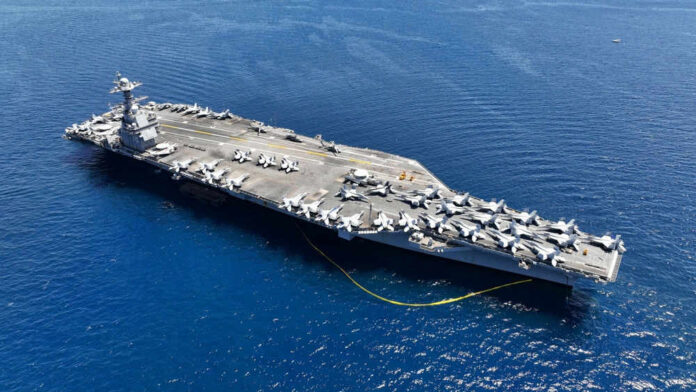
The Pentagon has ordered the USS Abraham Lincoln Carrier Strike Group to abandon its South China Sea operations and rush toward the Middle East as President Trump weighs military action against Iran’s embattled regime.
Story Highlights
- USS Abraham Lincoln redirected from the South China Sea to the Middle East amid the Iran crisis
- No US aircraft carriers are currently deployed in the CENTCOM region covering Iran
- Trump briefed on military strike options as Iranian protests enter third week
- Carrier group expected to arrive in the Gulf region within 7-13 days
Strategic Naval Redeployment Signals Escalation
The USS Abraham Lincoln Carrier Strike Group received urgent Pentagon orders to depart the South China Sea and transit toward US Central Command’s area of operations. The carrier group, including Arleigh Burke-class guided-missile destroyers, had been conducting live-fire exercises near the contested Scarborough Shoal as recently as January 8. Military sources describe this redeployment as “setting the force” for potential offensive operations against Iran’s Islamic Republic.
CENTCOM currently operates without carrier support across its 4 million square mile coverage area spanning 21 countries. The region maintains only three destroyers, three Littoral Combat Ships, and approximately 30,000 US troops. This carrier gap leaves American forces vulnerable while Iran’s regime faces unprecedented domestic unrest, creating a strategic window that demands immediate naval reinforcement to project American strength.
Iran Protests Trigger Military Response Options
Iranian anti-government demonstrations have raged for 18 consecutive days, generating 617 protest events across the country with over 18,470 arrests and 2,615 deaths according to Human Rights Activists News Agency. The protests stem from severe inflation, economic hardship, and widespread anger toward the Islamic Republic’s governance failures. Iran’s government has imposed communications blackouts while violently suppressing protesters demanding regime change.
President Trump received comprehensive military briefings on January 12 covering airstrikes, cyber operations, and psychological warfare options against Tehran. European officials warn that US forces could strike Iranian targets within 24 hours of receiving orders. The administration’s willingness to consider military intervention represents a decisive shift from previous appeasement policies that emboldened Iran’s terrorist activities and regional destabilization efforts.
Pentagon moving carrier strike group toward Middle East amid tensions with Iran https://t.co/V0ixvMGlgP
— The Hill (@thehill) January 15, 2026
Regional Powers Fear Wider Conflict
The carrier redeployment coincides with precautionary evacuations at Al Udeid Air Base in Qatar and US Embassy warnings to American citizens in Saudi Arabia. Regional governments privately express concerns about potential spillover effects from US military action, fearing economic disruption and proxy warfare expansion. Oil markets face volatility risks from Persian Gulf shipping threats, while Iran’s inflation crisis worsens popular unrest against the ayatollah’s rule.
This strategic pivot from China containment to Iran confrontation demonstrates Trump’s commitment to supporting freedom movements against authoritarian regimes. Unlike previous administrations that abandoned pro-democracy protesters, Trump’s positioning of overwhelming naval firepower sends an unmistakable message that America stands with those fighting tyranny. The Abraham Lincoln’s imminent arrival will restore credible deterrence against Iran’s nuclear ambitions and terrorist proxy networks threatening regional stability.
Sources:
US aircraft carrier steams from South China Sea to Mideast after Trump threat against Iran
US redeploying South China Sea carrier to Middle East amid tensions with Iran
US sending military assets to Middle East as Trump weighs Iran strike, sources say