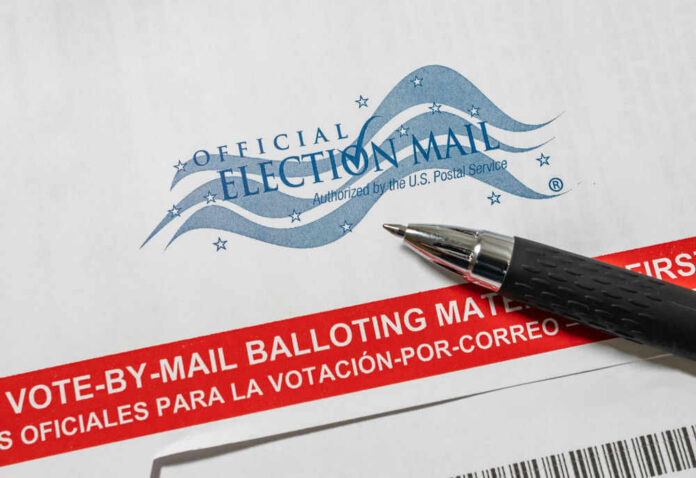
President Trump’s push to curb mail-in voting is colliding with a constitutional reality and a Republican strategy that has quietly relied on the very ballots he wants restricted.
Quick Take
- Trump urged Congress to move election legislation and pressed for limits on most mail ballots, while also pointing to the SAVE America Act as a priority.
- The SAVE America Act focuses on voter ID and proof-of-citizenship requirements, but it does not include the broad mail-ballot ban Trump has described.
- Senate rules and internal GOP divisions make sweeping mail-voting restrictions difficult, even with Republicans holding a narrow majority.
- Mail voting remains widely used—about 47 million counted mail ballots in 2024—meaning any major shift would disrupt how tens of millions vote.
Trump’s new pressure campaign targets mail ballots and Senate math
President Trump renewed his demand that Congress sharply limit mail-in voting, framing it as a high-stakes election integrity issue and urging lawmakers to act quickly. The White House push is occurring as the Senate faces a 60-vote threshold to advance major legislation under current filibuster rules.
With Republicans holding a narrow majority, any bill that cannot attract Democratic votes risks stalling, regardless of public pressure or party-line support.
Republicans in Congress have responded unevenly. Several members have applauded voter ID and proof-of-citizenship proposals, but broader restrictions on mail ballots have produced a cooler reception—especially from lawmakers representing states where mail voting is routine.
That split matters because election changes require more than slogans; they require durable votes, committee work, and a bill that can survive both chambers without splintering a caucus already balancing competing state election systems.
What the SAVE America Act does—and what it doesn’t
Trump has repeatedly pointed to the SAVE America Act as the vehicle for “common-sense” election reforms, but the research shows a key mismatch: the bill’s core is voter ID and proof-of-citizenship requirements, not a near-total mail-ballot ban.
A separate proposal, described as the Make Elections Great Again (MEGA) Act, is the one that includes more direct mail-voting restrictions, and it has not passed either chamber.
President Trump says he will not sign any bills into law until the SAVE America Act is passed. pic.twitter.com/C7p26CBLhX
— Political Polls (@PpollingNumbers) March 8, 2026
This disconnect creates a practical problem for lawmakers trying to translate presidential demands into statutory language. If Trump’s focus is mail-ballot limits while the best-known bill centers on citizenship and identification, Senate negotiations become harder and messaging becomes muddled.
For voters frustrated by years of chaotic election rules, the immediate question is not only “Do we want tighter standards?” but “Which bill actually does what the President says it does?”
Federal power has limits: states run elections unless Congress acts
Legal experts cited in the research emphasize that presidents do not control election administration the way federal agencies control regulations. States set the “times, places and manner” for federal elections, and Congress can override state rules through legislation.
That distinction matters because Trump has signaled openness to executive action if Congress does not deliver, but prior election-related executive efforts have faced major court resistance.
For conservatives who care about the Constitution as written, this legal boundary is central. Election integrity can be a legitimate public concern, but the method still has to fit constitutional structure.
When Washington tries to nationalize rules that have historically belonged to states, the result often becomes litigation, uncertainty, and last-minute changes that burden voters and administrators alike—exactly the kind of instability that undermines trust.
The GOP’s strategic dilemma: mail ballots are popular, and not clearly partisan
The research highlights a political contradiction Republicans are now forced to confront. GOP consultants have described mail voting as an advantage in certain states, and the party has spent heavily in recent cycles encouraging its voters to use mail ballots.
At the same time, Trump has attacked mail voting for years, including while personally using mail voting himself—fueling confusion about whether conservatives should embrace the method or reject it.
Studies referenced in the research also cut against the claim that mail voting automatically benefits Democrats. Reported findings indicate mail voting does not provide an inherent partisan edge, and states that expanded mail or early voting access have not shown an obvious party advantage.
If that is accurate, a sweeping rollback would not only pressure Democrats; it could also squeeze rural voters, military families, travelers, and elderly Americans who rely on mail access for practical reasons.
What changes could mean for voters, states, and the next court fight
Any successful federal restrictions would fall on a system currently serving tens of millions of voters. The research cites nearly 47 million counted mail ballots in 2024, roughly 30% of all votes cast.
That scale explains why some Republican lawmakers from mail-voting states have defended their systems as well-run and vital for rural communities. Reworking rules at that level would force states to retool procedures, budgets, staffing, and timelines.
The near-term outcome hinges on whether Senate leadership keeps the filibuster threshold intact and whether election provisions can attract cross-party support. If Congress deadlocks and the administration attempts executive action, the research suggests courts would again become the arena where election policy is decided.
For voters demanding secure, constitutional elections, the clearest takeaway is that outcomes will likely be shaped as much by Senate procedure and legal limits as by campaign-style pressure.
Sources:
Trump’s renewed attacks on mail voting collide with GOP campaign strategy
New GOP anti-voting bill may be the most dangerous attack on voting rights ever