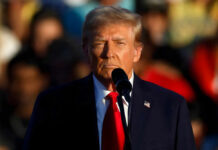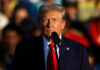
The most revealing thing about Trump’s abandoned $1.8 billion “anti-weaponization” fund is not that it died, but how close it came to quietly turning a private tax fight into a taxpayer-financed loyalty program.
Story Snapshot
- Trump agreed to drop his $10 billion tax-return lawsuit in exchange for a $1.776 billion Justice Department fund for supposed “weaponization” victims.
- The fund was explicitly structured to compensate Trump allies who claimed mistreatment by government agencies.[2]
- Conservatives in Congress split: some saw justice for overreach, others saw a political landmine framed as a “slush fund.”[3]
- Court resistance and public backlash pushed the administration to scrap the fund entirely.[2]
How a Personal Tax Fight Turned into a $1.8 Billion Idea
President Donald Trump sued the Internal Revenue Service over the leak of his tax returns, demanding $10 billion in damages and accusing federal officials of “weaponization” and “lawfare” against him and his supporters.[2]
The Justice Department eventually negotiated a settlement concept: Trump would drop the massive claim, and the government would create an “Anti-Weaponization Fund” of $1.776 billion, paid from the federal judgment fund, to compensate others who claimed similar political targeting.[2]
That pivot turned one man’s tax case into a sweeping political test of what counts as justice versus favoritism.
The proposed $1.8 billion fund designed to compensate allies of President Donald Trump who claimed they were prosecuted for political reasons is officially dead, Acting Attorney General Todd Blanche told lawmakers on Tuesday. https://t.co/0A3B45xfV1
— FOX 5 DC (@fox5dc) June 2, 2026
The Justice Department publicly framed the fund as a neutral claims process, not a payout list for Trump loyalists.[2] Officials said anyone who believed they suffered government “weaponization and lawfare” could apply, with no partisan requirement written into the rules.[2]
Supporters on the right argued that federal agencies had punished religious conservatives, Trump-world figures, and January 6 defendants, and that a formal mechanism to compensate abused citizens simply corrected long-standing imbalances.[1] On paper, the structure resembled earlier settlement funds used in discrimination and class-action cases.[2]
Why Critics Called It a “Slush Fund” for Allies
Democrats in Congress and watchdog groups saw something very different when they looked at the same design.[3] The universe of likely claimants overlapped heavily with Trump’s political base, including allies investigated during the Russia probe, January 6 rioters, and conservative activists claiming harassment by the Internal Revenue Service or Justice Department.[1][3]
Ranking Member Jamie Raskin and others blasted the fund as an attempt to raid the Treasury for “MAGA slush fund” payouts, bypassing normal appropriations and oversight.[3] For critics, the absence of explicit partisan language did not outweigh the obvious political tilt of who would qualify.
Concerns focused on three conservative bedrock principles: limited government, equal treatment under the law, and fiscal restraint. From that perspective, using a perpetual judgment fund to cut checks to politically aligned claimants looked less like accountability and more like patronage.[3]
The fact that the money would come from a standing federal cash pot, rather than a specific congressional appropriation, amplified accusations that the executive branch was effectively self-funding a political rewards program without a direct vote by the people’s representatives.
Courts Step In and the Administration Retreats
A federal judge in Virginia temporarily blocked the Trump administration from moving forward with any payouts from the nearly $1.8 billion fund, signaling serious constitutional and statutory questions about its legality. The Justice Department announced it would comply with the court order and pause all activity for at least two weeks.[2]
That pause coincided with growing bipartisan discomfort as more details emerged about the likely beneficiaries and the fund’s loose guardrails, raising the prospect of drawn-out litigation that could extend well beyond Trump’s term.
federal judge appointed by Bill Clinton has blocked Donald Trump from moving forward his plans to create a $1.8 billion taxpayer 'slush fund' to compensate his political allies.
Judge Leonie Brinkema ruled Friday that the Trump administration cannot establish an…— Simo Saadi (@Simo7809957085) May 29, 2026
Acting Attorney General Todd Blanche then told Congress the administration was abandoning the plan altogether.[2] “We are not moving forward with the fund, period,” he said in testimony on the department’s budget, confirming that the White House would no longer pursue the anti-weaponization mechanism as part of the settlement.[2]
Reports described internal conflicts inside the administration over the fund’s optics and legal risk, with advisers split between pressing ahead to signal toughness and backing off to avoid a damaging loss in court. The retreat left Trump without his $10 billion claim and his allies without the promised compensation vehicle.
What This Fight Reveals About Power, Grievance, and Taxpayer Money
This episode exposes a key tension inside modern conservative politics: the desire to combat real or perceived government overreach versus the need to keep the state from becoming an instrument of factional payback.
Many on the right sincerely believe agencies have targeted them, from Internal Revenue Service scrutiny of conservative nonprofits to aggressive prosecutions of Trump associates.[1]
Demanding redress for that culture of bias fits squarely within American values. The trouble comes when the remedy looks tailored to one politician’s network rather than to all citizens equally wronged.
Most Americans accept that a president should not turn a personal legal dispute into a multi-billion-dollar program whose benefits track his political base.
Even if every dollar were lawfully paid, the appearance problem alone would erode trust in neutral justice. The collapse of the anti-weaponization fund therefore functions as a warning shot.
Any future effort to address “weaponization” will have to be narrow, transparent, and rooted in clear evidence and due process—not in sweeping, backdoor deals tied to one man’s lawsuit.
Otherwise, what starts as a promise to protect citizens from politicized government quickly begins to look like politicized government in another form.
Sources:
[1] Web – Trump’s financial ties face scrutiny after moves benefiting allies and …
[2] YouTube – DOJ creates fund worth nearly $1.8 billion to pay Trump allies
[3] Web – Justice Department Announces Anti-Weaponization Fund