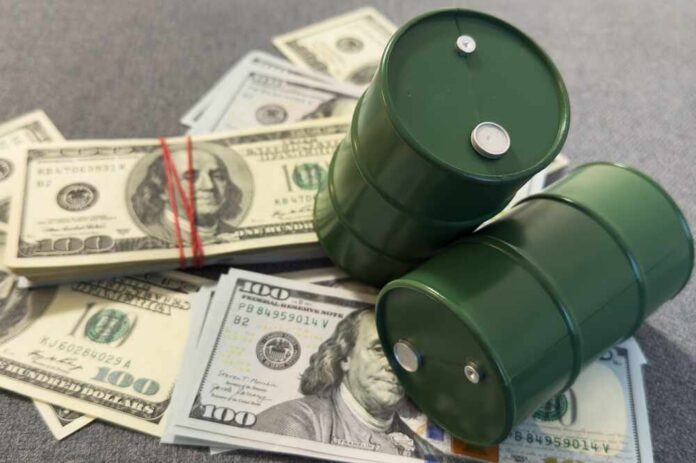
Oil prices are back near pre-war levels even as OPEC+ turns the output dial higher for the fifth month in a row, and that quiet shift could reshape everything from gas bills to election-year politics.
Story Snapshot
- Seven core OPEC+ countries approved a fresh 188,000 barrel per day increase for August
- Nearly 800,000 barrels per day of earlier cuts have now been restored since April
- Oil prices slid from wartime highs near $120–$126 down toward the low $70s
- Analysts warn of possible oversupply as demand slows and electric vehicles gain ground
OPEC+ moves from crisis manager to market manager
OPEC+ spent most of the recent US–Israel war on Iran in emergency mode, promising only modest increases while the Strait of Hormuz was partly shut and millions of barrels per day were stuck behind damaged infrastructure. That chapter is ending.
Seven core producers — Saudi Arabia, Russia, Iraq, Kuwait, Algeria, Kazakhstan, and Oman — have now approved another August hike of 188,000 barrels per day, their fifth straight monthly increase.
These same countries have brought back almost 800,000 barrels per day since April, unwinding voluntary cuts first introduced in 2023. The shift signals a move away from panic over missing barrels toward an old-fashioned fight over price and market share.
For everyday Americans, this matters more than it sounds. When Hormuz exports were choked and war headlines drove fear, Brent crude shot up into the $120s and talk of $150 oil felt real. That kind of spike hits gas stations, grocery shelves, and heating bills in short order.
Now, with shipments through Hormuz steadily recovering and spot prices hovering near pre-conflict levels around the low $70s, the cartel is adding supply into a calmer market.
Why a “small” 188,000 barrel increase still drives big arguments
The approved 188,000 barrel per day bump is tiny compared with the 12–15 million barrels disrupted at the height of the war, and far below past hikes of 548,000 or 648,000 barrels per day in earlier episodes. That scale has led some commentators to call the move symbolic rather than decisive.
But symbols matter in oil. OPEC+ is telling markets that crude supplies are recovering and that geopolitical danger is easing enough to justify a measured rollback of cuts.
At the same time, media outlets like CNBC and Bloomberg highlight “larger-than-expected” increases by broader coalitions of eight members and warn of looming oversupply, feeding a narrative that the cartel might be getting aggressive just as global demand starts to soften. The numbers themselves are not in dispute; what they mean is.
The confusion over volumes — 188,000 barrels per day for a seven-member core versus 548,000 barrels per day for a different eight-nation coalition in earlier reporting — gives critics room to question whether the latest move is truly modest or the first step in a bigger flood of oil.
This ambiguity is avoidable. When an alliance that can swing prices for the entire world changes output, it should publish clear, simple figures and stick to them. Vague math is great for cartel politics; it is terrible for family budgets.
Stabilizing prices or sowing the seeds of the next glut?
Supporters of the increase point to cooling prices as proof that more supply is needed. Brent crude has dropped from war highs near $120–$126 to about $70–$75, in line with pre-conflict ranges.
OPEC+ frames the latest hike as part of a cautious, flexible plan to phase out 2023’s voluntary cuts while “monitoring market conditions” and retaining the option to pause or reverse if the market weakens. That language matches a long pattern: the cartel claims to be defending stability, not chasing price spikes.
Research on past conflicts, like Russia’s war in Ukraine, backs up the idea that production announcements and war shocks together drive short-term price surges, while medium-term prices depend on demand and inventory, not press releases.
THIS IS STRANGE 🚨
OIL SUPPLY IS STILL 5 MILLION BARRELS A DAY SHORT, BUT PRICES ARE NEAR A 4 MONTH LOW.
Two tankers were hit on the Oman route in the last 24 hours. Iran's IRGC used missiles this time. Previous attacks used drones.
This is an escalation.
Brent is trading at… pic.twitter.com/qIjYY6LA2F
— The Macro Paper (@macropaperr) July 7, 2026
Skeptics, however, see the risk of the opposite problem: too many barrels. The International Energy Agency expects non-OPEC producers, especially the United States, Guyana, and Brazil, to keep adding supply, leaving the world with “loose” conditions and downward pressure on prices.
Investment banks warn that 2026 could bring the largest wave of non-OPEC+ supply in a decade. On top of that, Chinese demand growth is slowing, inventories have been rebuilt, and electric vehicles are eating into long-term fuel use. In that context, another 188,000 barrels per day looks less like a rescue and more like a step toward a future price crash if cartel discipline slips.
The quiet power shift behind “recovering supplies”
Behind the headlines about Hormuz and war, there is a deeper power shift. During the conflict peak, analysts openly said OPEC+ “couldn’t come to the rescue” because damaged pipelines and closed sea lanes left their promised increases mostly theoretical.
Now, with exports through Hormuz described as “continuing to recover” and prices near pre-conflict levels, the cartel is reclaiming its favorite role: self-proclaimed guardian of market stability.
Yet OPEC itself has offered no hard numbers on how many barrels have truly come back through Hormuz, how much spare capacity Russia has under sanctions, or how quickly damaged assets were repaired. That institutional silence is not illegal, but it keeps citizens in the dark and hands the microphone to anonymous sources and talking heads.
That gap should bother you more than the 188,000 barrel headline. When a small group of governments makes decisions that sway inflation, household energy costs, and national security, they should back their stories with data, not just careful phrases about “monitoring conditions.”
Concrete numbers on Hormuz flows, Russian capacity, and restored cuts would either confirm the “recovering supplies” narrative or expose it as spin.
Until then, the smartest stance is measured skepticism: accept the basic facts — the increase is real, prices are lower, more cuts are unwinding — but do not take the cartel’s framing as gospel. Watch the shipping lanes, watch non-OPEC supply, and watch whether promised barrels actually show up.
Sources:
foxbusiness.com, finance.yahoo.com, apnews.com, cnbc.com, reuters.com, youtube.com, facebook.com, linkedin.com, energypolicy.columbia.edu, sciencedirect.com