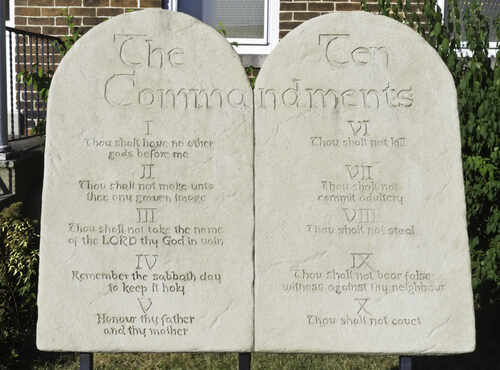
A federal appeals court just handed conservatives a stunning victory that could reshape how religion appears in American public schools, but the fight is far from over.
Quick Take
- Fifth Circuit Court of Appeals upheld Texas Senate Bill 10 in a 9-8 decision, allowing public schools to display Ten Commandments posters in every classroom
- The court rejected the 1980 Stone v. Graham precedent, ruling the display is not religious coercion because students are not forced to recite or study the text
- Civil rights groups including the ACLU vow to appeal to the U.S. Supreme Court, setting up a potential landmark religious liberty case
- The ruling aligns with recent Supreme Court decisions favoring religious expression in public spaces and could validate similar laws in Arkansas and Louisiana
A Seismic Shift in Church-State Law
The Fifth Circuit’s decision represents a fundamental departure from decades of Establishment Clause doctrine. The court majority concluded that displaying a 16-by-20-inch Ten Commandments poster on a classroom wall constitutes passive observation, not active religious instruction.
Judge Stuart Kyle Duncan wrote that the law punishes no one who rejects the commandments and imposes no religious exercise on students. This reasoning directly contradicts the 1980 Supreme Court ruling that struck down Kentucky’s identical requirement.
Texas's law requiring public schools to have a copy of the Ten Commandments posted in classrooms does not violate the Constitution, a federal appeals court ruled, plowing new ground in religious law. https://t.co/WSsT6NAZJj
— The Washington Times (@WashTimes) April 22, 2026
What makes this decision particularly significant is its timing and jurisdiction. The Fifth Circuit covers Texas, Louisiana, and Mississippi—solidly conservative territory. The 9-8 split reveals deep ideological fractures even within this court.
The majority leaned heavily on the 2022 Kennedy v. Bremerton Supreme Court decision, which expanded religious liberty protections for public employees.
That precedent emboldened the Fifth Circuit to declare Stone v. Graham obsolete, effectively dismantling a pillar of church-state separation law.
The Coercion Question That Divides America
The central legal battle hinges on what constitutes religious coercion. The majority of the court argues that a poster on a wall cannot coerce anyone. Students remain free to ignore it, and no curriculum requires them to study or memorize the commandments.
The state’s position is straightforward: this is a passive display requiring no student participation. Texas Attorney General Ken Paxton celebrated the ruling, framing the Ten Commandments as foundational to American law and culture rather than sectarian doctrine.
Opponents see it differently. The ACLU and multifaith families who sued argue that displaying biblical text in state-controlled classrooms sends an unmistakable message that the government endorses one religious tradition over others.
They point out that the Ten Commandments exist in multiple versions across faiths, and the law mandates a specific Protestant interpretation.
For families whose beliefs conflict with the commandments, the poster creates an uncomfortable daily reminder that their worldview lacks official sanction in their children’s schools.
Why This Case Matters Beyond Texas
Texas did not act alone. Louisiana passed a similar law in 2024, and Arkansas enacted comparable legislation. Lower courts blocked implementation in Arkansas, citing concerns about religious coercion.
The Fifth Circuit’s decision now provides legal cover for these states to proceed. More critically, it signals to legislatures nationwide that the judicial climate has shifted decisively toward permitting religious displays in public institutions.
The Supreme Court looms as the inevitable final arbiter. The ACLU has already announced its intention to appeal, and such a case would reach the Court with a 6-3 conservative majority that has consistently favored religious liberty claims.
If the Supreme Court affirms the Fifth Circuit, it would fundamentally rewrite Establishment Clause jurisprudence. The Court would be signaling that government neutrality toward religion no longer means government silence about religion—a seismic shift with implications far beyond classroom posters.
The Practical Reality in Texas Schools
Legally speaking, Texas schools must now display the commandments unless a lower court issues a temporary injunction in specific districts. A San Antonio federal judge previously blocked implementation in eleven school districts, but that narrow ruling does not apply statewide.
Most Texas schools face pressure to comply. The law requires donated posters measuring at least 16 by 20 inches to be displayed in a conspicuous location, but does not specify consequences for non-compliance, creating enforcement ambiguity.
Federal appeals court upholds Texas law requiring Ten Commandments in classrooms https://t.co/mspqsYM1sx
— CBS News (@CBSNews) April 22, 2026
Administrators face genuine dilemmas. Some will embrace the requirement as an expression of cultural values. Others worry about alienating non-Christian families or inviting litigation. The practical effect depends on how aggressively the state enforces compliance and how quickly courts intervene.
For now, Texas has legal permission to proceed, but the battle is shifting to the Supreme Court, where the nation’s fundamental approach to religion in public life hangs in the balance.
Sources:
ACLU: Fifth Circuit Upholds Law Requiring Display of Ten Commandments in Public School Classrooms
ABC News: Texas to Require Public Schools Display Ten Commandments in Classrooms
CBS News Texas: Federal Appeals Court Upholds Texas Law Requiring Ten Commandments in Classrooms
Fox News: Federal Court Upholds Texas Law Requiring Ten Commandments in Public Classrooms
KTVU: Texas Public Schools Can Display Ten Commandments, Appeals Court Rules
Texas Tribune: Texas Can Require Ten Commandments in Classrooms, Court Says