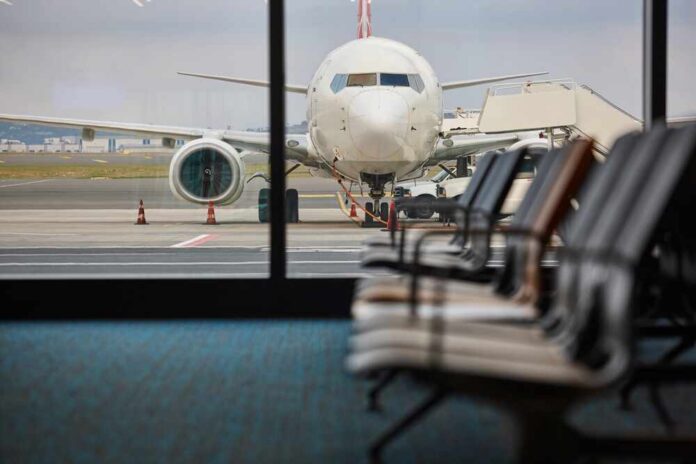
On the hottest days, rising summer heat is now powerful enough to bump passengers, cut fuel and stall your vacation before the plane even leaves the ground.
Story Snapshot
- Extreme heat makes air thinner, forcing some planes to shed weight or delay takeoff.
- Studies project 10%–30% of hot‑hour departures at many major airports could face weight limits by midcentury.
- Recent heat waves in North America and Europe have already triggered hundreds of delays and cancellations in single days.
- Airlines are shifting schedules, cutting payloads, and bracing for a future where scorching summers mean more disrupted trips.
Heat is turning physics into a travel headache
Summer travelers now face a new kind of weather problem: days that are simply too hot for normal takeoff. Aviation experts explain the core issue in simple terms. Hot air is less dense, which means wings create less lift and engines produce less thrust at the same speed.
To get off the ground safely, a plane either needs more runway, more speed, or less weight. When runway length and engine limits cannot change, weight becomes the lever, and that is where delays begin.
On triple‑digit days, some aircraft types hit their certified performance ceiling. At temperatures above about 110 to 120 degrees Fahrenheit, smaller regional jets are often the first to run into trouble. Airlines respond by reducing payload: offloading baggage, carrying less fuel, or in some cases asking a few passengers to take a later flight.
Each of those actions takes time. Ground crews must reshuffle cargo, rework fuel plans, and sometimes rebook travelers, turning a physics limit into a long line at the gate.
Research shows heat‑driven delays will grow
A landmark study from Columbia University, working with the National Aeronautics and Space Administration (NASA) and other partners, modeled how rising temperatures will stress airports around the world. Their projection is blunt.
By midcentury, if greenhouse gas emissions keep climbing, 10 percent to 30 percent of flights departing during the hottest hours at 19 major airports could face weight restrictions. On the very hottest days after 2050, some planes may need to cut up to 4 percent of their weight to meet performance rules.
Rising temperatures are forcing airlines to delay flights or reduce passenger loads because hot, thin air decreases airplane lift. Travelers should prepare for potential heat-related delays as extreme summer weather impacts nationwide flight schedules. https://t.co/PfgXe34FV6 pic.twitter.com/tKaAaHLJk8
— KTBS (@KTBS) August 5, 2026
Short runways, high elevation, and already hot climates face the steepest challenges. Airports like New York’s LaGuardia, which has limited runway length, or Phoenix, which mixes heat with altitude, are particularly exposed. Phoenix Sky Harbor International Airport now averages 43 days a year at or above 110 degrees, more than triple the mid‑century average.
Las Vegas has seen its count of 110‑degree days more than double compared with the 1940s through 1960s. These are not abstract climate charts; they are the days when travelers bake in jetways while dispatchers redo the math.
Real‑world heat waves are already grounding planes
Recent summers offer a preview of that midcentury future. During a record European heat wave in May 2026, weather‑related restrictions triggered 1,391 delays and 62 cancellations in a single day, totaling 1,453 disrupted flights.
In Canada, a July heat wave produced 356 delays and 83 cancellations across major airports, including Toronto Pearson and Montreal. Travelers saw “normal” sunny days that nonetheless jammed schedules because the atmosphere itself had become a performance obstacle.
In the United States, local reporting from Harry Reid International Airport in Las Vegas described scorching heat forcing rare weight limits and altered takeoff procedures, with delays rippling through the system. Business outlets have chronicled how high temperatures are now making airlines shed fuel or limit passengers on select routes in sun‑baked cities.
When people hear “extreme weather,” they often think hurricanes or blizzards. These events show something quieter but more structural: rules‑based safety decisions triggered by temperature, not politics.
Climate change is loading the dice for summer disruption
Weather alone has always caused delays, and crew shortages, congestion and storms still play large roles. However, there is growing evidence that human‑driven climate warming is changing the baseline that airlines must plan around.
Meteorologists point out that heat waves are becoming more intense and more frequent as the planet warms. More days push into the range where density altitude, the effective thinness of the air, moves from a textbook concept to a hard operating limit on commercial flights.
The key point is not to panic but to recognize cause and effect. When regulations say a plane must meet certain climb and performance numbers, pilots and airlines do not get to fudge those rules because the gate area is crowded. They must adapt.
The International Civil Aviation Organization has already suggested shifting heavy departures to cooler times of day where higher temperatures challenge takeoff performance. That means more red‑eye flights, more dawn departures, and more trade‑offs with local noise concerns, especially in cities.
How airlines and travelers can respond
Airlines are far from helpless. Carriers are revising scheduling models, investing in more capable aircraft, and refining dispatch plans to handle hot‑day constraints.
During peak heat, companies may spread departures out, favor longer runways when possible, or add planned fuel stops so aircraft can take off lighter and refuel later.
These moves protect safety but can reduce efficiency, ultimately raising costs and complicating already tight summer networks. It is a classic operational puzzle: keep everyone safe, on time, and profitable while the thermometer creeps up.
Travelers can stack the odds in their favor with simple steps. Aviation experts stress that early morning and late evening flights are least likely to be affected by heat because temperatures are lower and the day’s delay chain has not yet formed.
Booking nonstop routes through less heat‑prone hubs, choosing northern airports for connections in summer, and avoiding tight layovers in very hot cities can all reduce risk.
These are not political gestures; they are practical adaptations in a world where summer weather now means more than just thunderstorms on the radar.
Sources:
abcnews.com, erau.edu, nbcnews.com, weather.com, reddit.com, scientificamerican.com, ndtv.com, forbes.com, washingtontimes.com, fox35orlando.com, bloomberg.com, 0e190a550a8c4c8c4b93-fcd009c875a5577fd4fe2f5b7e3bf4eb.ssl.cf2.rackcdn.com, youtube.com, time.com, cbsnews.com, facebook.com