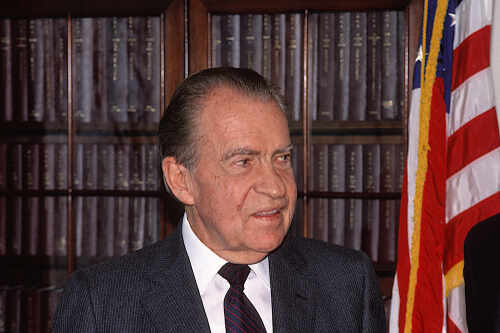
Alexander Butterfield, the honest Nixon aide whose truthful testimony toppled a corrupt presidency by exposing the abuse of secret Oval Office tapes, has passed away at 99—reminding us today why accountability must always check executive overreach.
Story Highlights
- Butterfield died Monday at his La Jolla, California, home at age 99, his wife, Kim, confirmed.
- His July 16, 1973, Senate testimony revealed Nixon’s secret taping system, exposing the Watergate cover-up.
- Never implicated in a scandal, Butterfield oversaw White House security and acted in good faith under oath.
- Tapes led to Nixon’s 1974 resignation, setting a precedent against presidential secrecy and abuse of power.
- Long-term legacy: Spurred reforms like the 1978 Presidential Records Act to protect public trust.
Butterfield’s Life and White House Role
Born April 6, 1926, in Pensacola, Florida, Alexander Butterfield attended UCLA briefly before joining the Air Force in 1948, retiring as colonel. College friend H.R.
Haldeman recruited him to Nixon’s administration in 1969 as a deputy assistant. Butterfield handled security, served as Cabinet secretary, and oversaw operations from 1969 to 1973.
Nixon ordered a secret taping system in April 1971 for historical records, and, in early 1972, expanded it to the Oval Office, with five hidden microphones, the Cabinet Room, the Lincoln Sitting Room, and Camp David. Secret Service technicians installed it under Butterfield’s supervision. Few knew: Nixon, Haldeman, select aides, and technicians.
The Watergate Break-In and Taping Revelation
On June 17, 1972, Nixon-linked operatives broke into Democrat National Committee headquarters at the Watergate complex, sparking investigations.
John Dean testified in June 1973 about possible recordings, prompting Senate committee staff, including Republican Fred Thompson, to question witnesses routinely.
Butterfield privately revealed the system on July 13, 1973. Publicly, on July 16, before the Senate Select Committee on Presidential Campaign Activities, he confirmed that it recorded all Nixon’s conversations when present. The testimony stunned observers, promising a rich vein of evidence.
Alexander Butterfield, the White House aide who inadvertently hastened Pres. Nixon’s resignation over the Watergate scandal when he revealed the president bugged the Oval Office and Cabinet Room and routinely recorded his conversations, has died at age 99. https://t.co/R5LtE1oKXG pic.twitter.com/Wedc9lEVb6
— World News Tonight (@ABCWorldNews) March 9, 2026
Impact of the Tapes on Nixon’s Downfall
Butterfield’s disclosure accelerated subpoenas for tapes, revealing Nixon’s June 23, 1972, “smoking gun” order to obstruct the FBI probe—a clear cover-up.
The Supreme Court ordered release in 1974, forcing Nixon’s resignation in August, the first by a U.S. president. Butterfield, already the FAA administrator, faced no charges, viewing tapes as historical records.
His action checked executive privilege claims, upholding constitutional oversight amid post-1960s distrust. Nixon’s paranoia from prior scandals, like the enemy lists, fueled the system, but truth prevailed.
Butterfield later criticized Nixon as “not an honest man” and “a crook” in a 2008 oral history, and cheered the resignation as just. He felt partial responsibility yet praised Nixon’s foreign policy while condemning the pre-break-in cover-up orchestration.
The Man who made a Difference
Alexander Butterfield, the Nixon aide who disclosed Watergate tapes, dies at 99
the White House aide who caused Nixon’s resignation over the Watergate scandal when he revealed that the president had bugged the Oval Office and Cabinet Room— Peter (@PeterP1949) March 10, 2026
Lasting Legacy and Reforms
Nixon officials faced prosecutions; power shifted to Gerald Ford. Public trust eroded post-Vietnam and Watergate, deepening cynicism. Politically, it spurred the 1978 Presidential Records Act, which promotes transparency. Congress gained stronger oversight of the executive branch. Journalism and investigations have been professionalized.
Butterfield’s death Monday in La Jolla closes a chapter on a peripheral aide whose oath-bound honesty exposed abuse, reinforcing conservative principles of limited government and accountability in 2026 under President Trump.
Sources:
Alexander Butterfield, Nixon aide who revealed existence of Watergate tapes, dies at 99
Alexander Butterfield, Nixon aide who revealed Watergate tapes, dies at 99
Alexander Butterfield, the Nixon aide who disclosed Watergate tapes, dies at 99
Alexander Butterfield, the Nixon aide who disclosed Watergate tapes, dies at 99
Alexander Butterfield – Wikipedia