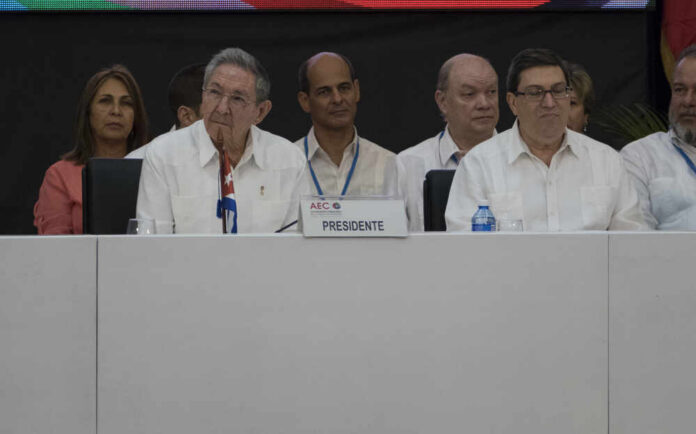
The United States is weighing a felony case against Raúl Castro over a three-decade-old shootdown that four families—and one federal judge—already call murder.
Story Snapshot
- Federal prosecutors are reportedly preparing charges tying Raúl Castro to the 1996 downing of two Brothers to the Rescue planes that killed four civilians [1][2].
- Fidel Castro publicly accepted responsibility in 1996; later reporting says both Fidel and Raúl assumed responsibility, though no U.S. criminal case has ever reached them personally [3].
- A federal court previously held Cuba liable for murdering four men in international airspace and awarded families $187 million [3].
- The evidentiary file—especially audio intercepts and command-chain proof—remains largely unseen by the public [1][2][4][5].
What prosecutors appear to be building and why it matters now
Reporting says the United States Department of Justice is preparing to seek an indictment of Raúl Castro over the February 24, 1996 shootdown of two Brothers to the Rescue planes, an episode that left four men dead over the Florida Straits [1][2].
Reuters-style summaries describe sources familiar with the matter rather than on-the-record officials, which signals that the case is still being shaped behind grand jury secrecy [1][2][5]. The prospective charges would test individual accountability decades after civil courts already ruled the Cuban state responsible [3].
Any indictment would likely argue that the victims were United States persons and that the attack occurred in international airspace, placing the conduct squarely in reach of United States criminal law and long-arm jurisdiction [1][2][3].
The names of the dead—Armando Alejandre, Mario de la Peña, Carlos Costa, and Pablo Morales—anchor the case in a precise factual record that has endured countless anniversaries and diplomatic resets without criminal closure [3].
The timing links with a broader pressure campaign on Cuba reported during the Trump era, which critics will cite as political, and supporters will call overdue [1][2].
The record already in the sunlight: admissions, rulings, and the civil judgment
Fidel Castro told an interviewer from a major United States network in 1996 that he assumed responsibility and that the Air Force acted under a standing order to end repeated incursions, a statement later widely quoted in United States media [3].
The Miami wrongful-death case, heard by Judge James Lawrence King, concluded that Cuba murdered four human beings in international airspace and entered a $187 million judgment, a portion of which was paid from frozen Cuban assets [3].
Those public facts give prosecutors moral gravity and a legal backdrop even if they do not, by themselves, prove Raúl Castro’s personal culpability.
Later reporting asserts that both Fidel and Raúl Castro took responsibility for the order, but those accounts still fall short of producing a charging document or an authenticated chain-of-command exhibit tying Raúl to specific instructions on the day of the shootdown [3]. That distinction matters.
American juries do not convict on aura or office alone; they look for concrete proof of knowledge, authority, and intent.
The unresolved gap: command responsibility and the unseen audio
Media accounts reference audio evidence—some describing Cuban pilots celebrating the downing, others referencing a clip reportedly capturing a Castro giving an order—but the underlying tapes, transcripts, and authentication logs have not been made available in full to the public [4][5].
Without chain of custody and voice attribution, the clips function as teasers, not trial-grade proof. Prosecutors likely also possess radar tracks, intercept logs, and witness statements that could stitch causation and command together, but none of that has appeared in open sources to date [1][2][5].
Defense arguments, previewed in prior years, lean on Cuba’s claim that the aircraft violated Cuban airspace, which, if true, would be marshaled to justify an intercept response under sovereignty and self-defense theories [2].
The federal court’s finding that the killings happened in international airspace undermines that narrative in civil context, but a criminal case still must establish who ordered what, when, and with what knowledge of airspace and target identity [3]. The legal load-bearing wall remains individual mens rea, not generalized outrage.
What accountability would signal for law, policy, and memory
A successful indictment would establish that even the most insulated leaders can face courtroom scrutiny long after the news cameras move on. That serves a core American value: law applies to rulers and ruled alike.
Yet prudence demands skepticism toward cases unveiled amid geopolitical campaigns. Prosecutors need to separate legal facts from policy theater by unsealing as much admissible evidence as the rules allow and by anchoring charges to statutes with clean jurisdictional hooks, not rhetoric [1][2][3][5].
By JOSHUA GOODMAN, ALANNA DURKIN RICHER and ERIC TUCKER MIAMI (AP) — The Justice Department is preparing to seek an indictment against former Cuban President Raúl Castro, three people familiar with the matter told The Associated Press on Frid… https://t.co/VEJAMjmw8W
— Capital Gazette (@capgaznews) May 15, 2026
The families have waited thirty years while anniversaries piled up and diplomacy zigzagged. If the government can show authenticated command audio, credible witness testimony from within the Cuban chain of command, and corroborating intercepts, the path to trial looks real.
If it cannot, the moment risks becoming one more symbolic swing at Havana that satisfies talk shows but not the rule of law. The next filing in Miami will reveal which it is [1][2][3][5].
Sources:
[1] Web – DOJ Seeks Raúl Castro Indictment Over 1996 Brothers to the …
[2] Web – U.S. reportedly preparing criminal charges against Raúl Castro over …
[3] Web – Raúl Castro’s indictment expected to be unsealed in Miami
[4] YouTube – DOJ seeks to indict Raúl Castro in 1996 Brothers to the Rescue …
[5] Web – US Considers Indicting Former Cuban President Raúl Castro Over …