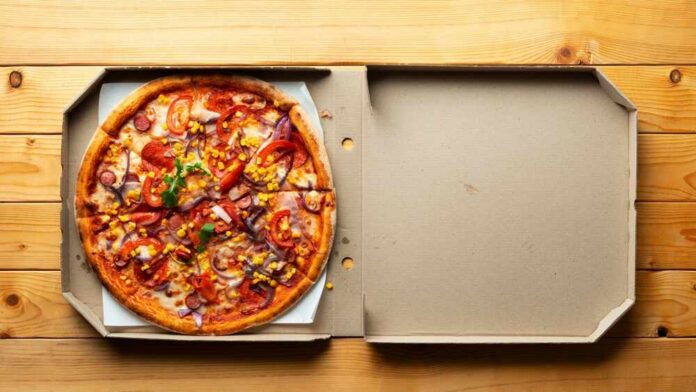
A simple message printed on a pizza box just exposed the fault lines in America’s broken tipping economy, and the outrage tells you everything about how fed up customers have become with subsidizing corporate wage strategies.
Story Snapshot
- Papa John’s printed “DELIVERY FEE IS NOT A TIP” on pizza boxes, sparking viral backlash when a TikTok user exposed the message
- Surveys reveal 90% of Americans believe tipping is “out of control,” with 66% admitting they tip out of guilt rather than service quality
- Delivery drivers warn that third-party app tips may not reach workers, recommending cash payments to bypass corporate interference
- The CEO earns $8.44 million annually while the company relies on customer guilt to compensate delivery workers
When Corporate Messaging Backfires Spectacularly
TikTok user @sydneeee___ opened her Papa John’s delivery last week and found more than pizza inside. Stamped directly on the box lid was a corporate directive: “DELIVERY FEE IS NOT A TIP. Please reward your driver for outstanding service.”
The video exploded across social media, racking up thousands of comments from customers who saw the message as the final insult in America’s tipping arms race.
What Papa John’s likely intended as helpful clarification instead became Exhibit A in the case against corporations that charge delivery fees, pay low wages, then ask customers to make up the difference.
Papa John's box message telling customers to tip delivery drivers sparks fierce tipping culture debate online https://t.co/US3b8QIv3J
— FOX Business (@FoxBusiness) April 21, 2026
The timing could not be worse for the pizza chain. WalletHub released survey data in March 2026 showing 90% of Americans consider tipping out of control.
A separate Popmenu report found 77% believe the practice has gone too far, with two-thirds admitting they tip from guilt rather than genuine appreciation for service.
These numbers represent a seismic shift in consumer tolerance for what many now view as emotional extortion at every point of sale. The Papa John’s box became a lightning rod because it made explicit what customers increasingly resent: businesses engineering guilt into transactions while pocketing fees that never reach workers.
The Delivery Fee Shell Game Nobody Asked For
Customers paying Papa John’s delivery fees assume that money compensates drivers for fuel, vehicle wear, and time. That assumption proves incorrect.
The delivery charge goes to the company, covering administrative costs and padding profit margins, while drivers depend almost entirely on tips for meaningful compensation.
This creates a bizarre economic theater where customers pay twice for the same service, once in mandatory fees to the corporation and again in socially coerced tips to workers. The printed message essentially admits this arrangement exists, then asks customers to accept it as normal.
The situation grows murkier when third-party delivery apps enter the equation. Drivers working through DoorDash or Uber Eats report that Papa John’s locations sometimes pocket portions of online tips rather than passing them through completely.
Reddit users on forums dedicated to delivery work have flagged the chain repeatedly for “retracted or stolen” tips.
While drivers employed directly by Papa John’s reportedly receive their full tip amounts, gig workers face a labyrinth of wage practices that vary by location and leave them uncertain whether their compensation will arrive intact. The solution many drivers now advocate? Cash tips are handed directly to the person at your door, eliminating corporate middlemen entirely.
Executive Pay Versus Driver Pleas
Social media users wasted no time highlighting the contrast between Papa John’s CEO compensation and the company’s reliance on customer generosity to pay frontline workers. Comments flooded in, noting the chief executive’s $8.44 million annual salary, while box messages beg customers to “reward” drivers.
This juxtaposition captures precisely why the tipping debate has morphed from an etiquette discussion into a class grievance. Americans understand that profitable corporations with highly compensated leadership possess the resources to pay living wages without customer subsidies.
The choice to print guilt-inducing messages rather than raise base pay reveals priorities that customers find increasingly offensive.
The backlash extends beyond Papa John’s to the entire delivery ecosystem. Tip screens now appear at coffee counters, fast-casual registers, and self-checkout kiosks where no traditional service occurs.
Each prompt trains customers to view generosity as mandatory, eroding the voluntary nature that once defined American tipping culture.
The fatigue is real and measurable. When 90% of survey respondents call the system broken, that represents a consensus spanning political and demographic divides. People across the spectrum recognize they are being asked to solve a corporate wage problem that businesses created and could easily fix.
What Happens When Guilt Stops Working
Papa John’s has issued no formal response to the viral backlash, leaving the printed message to speak for company policy. That silence may prove costly as customers increasingly question why they should feel obligated to supplement wages at profitable corporations. The short-term impact shows up in social media sentiment and potential customer defection.
The long-term consequences could reshape industry wage structures if enough consumers simply refuse to participate in guilt-based compensation systems. Surveys suggesting 77% exhaustion with current tipping norms indicate the foundation for such a shift already exists.
Drivers caught in the middle face impossible choices. They need tips to survive on wages that rarely exceed minimum thresholds without customer generosity. Yet they also recognize that the box messages and tip screens alienate the very people they depend on for income.
Some have started advocating for cash tips as a workaround, creating informal alliances with customers against corporate practices both groups resent.
This dynamic, where workers and customers unite against employer policies, historically precedes either regulatory intervention or significant business model changes. Papa John’s printed message may eventually be remembered as the moment tipping culture’s contradictions became too obvious to ignore.
Sources:
Papa John’s Delivery Driver Online Tip – BroBible