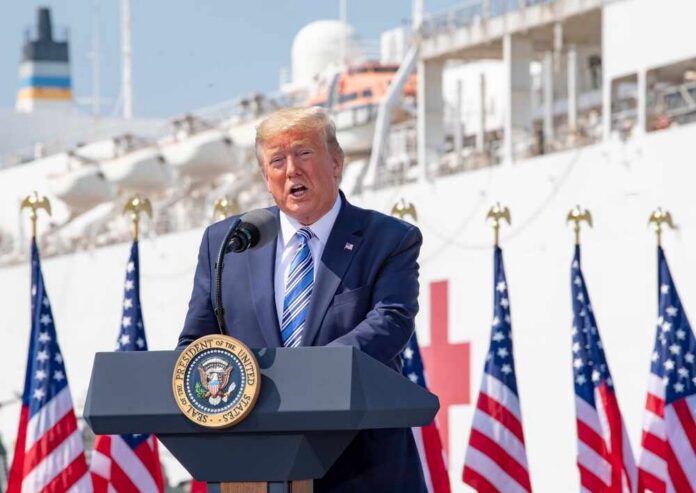
Trump’s 37% approval is not just a bad headline; it is a warning flare about a presidency losing its political shock absorbers.
Story Snapshot
- The New York Times/Siena 37% result matches a broader slide into the high-30s across multiple pollsters.
- Independent voters and soft Trump supporters are peeling away, not just dug‑in Democrats.
- Poll critics are right about methodological quirks, but wrong to ignore the trend line.
- For conservatives, the danger is not one poll; it is governing without a stable consent of the governed.
Trump’s 37 Percent: Outlier or Confirmation?
The headline number is simple: a New York Times/Siena survey reports President Trump at 37% approval, his low point of the second term. Poll skeptics immediately ask whether that is “real.” The cleaner question is whether other credible data put him in the same neighborhood. The answer is yes. A weighted approval tracker at FiftyPlusOne has him at about 36.7% approval and 59.9% disapproval in mid‑May 2026, almost a carbon copy of the 37% finding.[1]
Trump approval rating hits second-term low in new pollinghttps://t.co/05kx1RraoA
— The Hill (@thehill) May 18, 2026
Broader trend data point in the same direction. Statista’s compilation of presidential approval polling shows Trump at “about 40 percent” approval as of May 4, 2026.[4] That is not a precise duplicate, but it is in the same band: a president stuck in the high‑30s to roughly 40 range. Once multiple independent sources cluster around the same zone, the odds that one pollster simply “goofed” drop sharply. The picture is noisy, but coherent.
From Support to Shrug: The Softening Within Trump’s Own Coalition
Public polling on Trump’s second term reveals something more worrisome for the White House than loud liberal opposition: erosion among people who once backed him. Pew Research Center finds his job approval in the mid‑30s and notes that traits like “keeps his promises” and “can use military force wisely” have slid compared with early in the term.[3] That kind of movement rarely comes from die‑hard partisans; it usually reflects disillusionment among the center‑right and the politically exhausted.
Pew’s breakdown of Trump’s 2024 voters shows the crack in the foundation.[3] Overall approval among his own voters remains high but is drifting down, especially among younger and Hispanic supporters. Trump voters under 35 now approve at far lower rates than those over 50. Hispanic Trump voters have seen approval drop much more sharply than White Trump voters. Those are precisely the marginal supporters who gave him another shot in 2024; losing them risks turning a winning coalition into a stalemate.
The Independent Voter Rebellion
Gallup’s national polling during Trump’s second term shows independents as the epicenter of the backlash. Its July 2025 survey places his overall approval at 37%, but the deeper punchline is that independents approve at just 29%, tying their all‑time low rating for him across both presidencies.[1] Independents give him no better than mid‑30s approval on any major issue, and only 19% approve of his handling of the federal budget.[1] That is not normal partisan grumbling; it is a revolt by the political middle.
For conservatives who want a durable policy legacy—on judges, regulation, immigration, or foreign policy—this matters more than social‑media chest‑thumping. A Republican president who cannot keep independents in at least the low‑40s gives Congress every incentive to distance itself, slow‑roll priorities, and quietly prepare for succession. Historical comparisons make the point stark.
Trump’s second‑term second‑quarter approval, around 40%, is far below the post‑war presidential average and comparable only to Bill Clinton’s and Richard Nixon’s pre‑Watergate‑collapse numbers.[1]
Are the Polls Rigged, Or Is The Ground Really Shifting?
Trump allies counter that polls like New York Times/Siena are biased: wrong samples, skewed questions, liberal sponsors. They are not entirely wrong to raise methodological flags. The publicly available record often offers only summaries of topline numbers, without full questionnaires, field dates, or weighting details, making it impossible for outsiders to run a full forensic audit. Serious poll consumers should always ask who was surveyed, how, and in what context.
ABC Poll: Trump approval rating drops to 37%.
— Bruce (@FireNewz) May 18, 2026
However, common sense requires weighing those concerns against the convergence of independent measures. When a Times/Siena result near 37% lines up with a 36.7% average at FiftyPlusOne and a roughly 40% figure on Statista within days of each other, the more plausible explanation is that the president really is mired in the high‑30s.[1][4] A conservative approach to evidence does not cherry‑pick only the friendly numbers; it looks at the whole set and asks whether the pattern holds.
What Low‑40s Polling Means for Conservative Governance
Consistently weak approval has consequences beyond the next news cycle. A president governing from the high‑30s can still issue orders and sign bills, but he does so with shrinking political capital. Regulators take more legal risks when they believe courts and the public will back them; lawmakers compromise less when they assume the White House cannot mobilize swing voters. Low approval shrinks the zone where principled conservative policy can actually become durable law.
The deeper danger for the right is confusing personality loyalty with policy strength. YouGov’s long‑running favorability tracker shows Trump’s personal image fluctuating across the decade, while job‑approval measures now stubbornly sit below 40%.[5] That gap means many Americans may still see him as a fighter but doubt his effectiveness as a steward. For conservatives serious about securing borders, taming inflation, or restraining the federal bureaucracy, that is the wake‑up call buried inside the 37% headline.
Sources:
[1] Web – Latest Donald Trump Approval Polls and Average for 2026
[3] YouTube – Trump’s recent polling, MAHA math & more | Enten roundup
[4] Web – Trump presidential approval rating U.S. 2026 – Statista
[5] Web – Donald Trump favorability 2016-2026 – YouGov