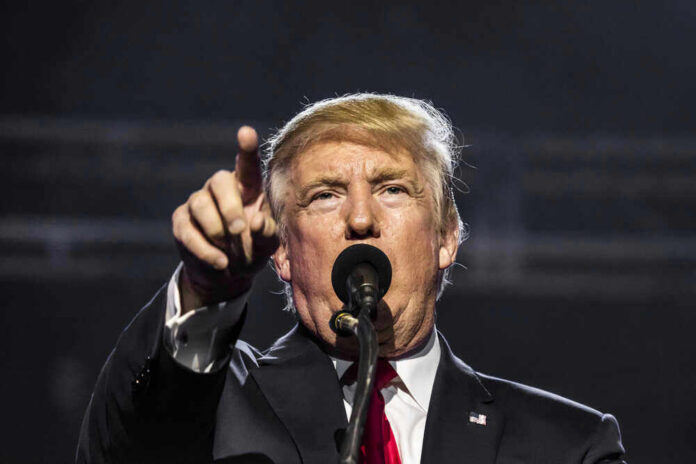
President Trump’s claim that the Iran operation was “very complete” is rattling the old foreign-policy playbook—and forcing Americans to ask what “complete” means when a regime change message follows a massive strike campaign.
Quick Take
- U.S. and Israeli forces launched a large-scale air campaign against Iran on Feb. 28, 2026, under the codenames Operation Epic Fury (U.S.) and Operation Roaring Lion (Israel).
- President Trump publicly described the operation as “very complete,” tying it to disabling Iran’s nuclear and missile programs and urging Iranians to rise against their government.
- Reporting and summaries indicate Iran’s Supreme Leader Ali Khamenei was killed in the opening phase, a major escalation compared with prior rounds of strikes.
- Iran retaliated with missiles and drones across the region as the U.S. accepted a negotiation proposal while keeping forces positioned through mid-March.
What Happened on Feb. 28—and Why “Very Complete” Matters
President Donald Trump announced that U.S. and Israeli forces struck Iran in the early hours of Feb. 28, 2026, describing the outcome as “very complete.” Accounts of the opening period describe nearly 900 strikes in the first 12 hours, hitting multiple locations including Tehran, Isfahan, Qom, Karaj, and Kermanshah.
The campaign’s stated targets included nuclear facilities, missile infrastructure, and senior leadership, setting this episode apart from limited deterrence strikes.
Trump says Iran 'war is very complete,' talks to Putin: Reports https://t.co/1PJTdh2c7H
— CNBC (@CNBC) March 9, 2026
Public messaging became part of the operation itself. A reported eight-minute Trump video posted in the early morning hours framed the strikes as a response to decades of “menacing activities” since 1979 and explicitly encouraged regime opposition.
For conservatives who watched prior administrations lean on stalled diplomacy, that plainspoken posture signals a major change in priorities: targeting capabilities that threaten American troops, allies, and global energy routes—rather than extending talks without enforceable results.
From Stalled Geneva Talks to a Decapitation-Style Strike
Background reporting links this flashpoint to long-running hostility dating to the 1979 revolution, Iran’s backing of regional proxies, and the nuclear dispute after the U.S. left the 2015 deal. The research summary also notes uranium enrichment at 60%, described as near weapons-grade.
In early 2026, protests and warnings escalated, and U.S. carrier deployments increased, placing major naval assets in theater while negotiations in Geneva remained “far apart.”
This campaign’s defining feature is the reported killing of Supreme Leader Ali Khamenei in the initial wave—paired with language that goes beyond containment. Analysts cited in the research characterize the strikes as intended to topple the regime and neutralize nuclear, missile, and naval threats.
That framing clarifies why the White House can call the operation “complete” even as the region remains volatile: completeness appears tied to mission objectives, not instant regional calm.
Civilian Casualties, Disputed Responsibility, and the Limits of What’s Confirmed
The same reporting that describes wide targeting also highlights tragic civilian losses, including more than 160 deaths at a girls’ school near Minab cited as collateral damage in strike reporting. Responsibility for that incident is disputed in the research summary, with an investigation referenced and denial attributed to Israel.
That uncertainty matters for credibility: conservative readers can support decisive action against a hostile regime while still insisting that U.S. operations uphold lawful targeting standards and verify claims in a fog-of-war environment.
Retaliation, Negotiations, and What Comes Next for U.S. Interests
After the strikes, Iran responded with missiles and drones across the Middle East, while travel disruptions and broader instability mounted. The research summary places the death toll above 1,000 and notes stranded travelers and infrastructure damage.
Even with Trump’s “very complete” description, the administration reportedly accepted a negotiation proposal while maintaining a timetable that points to operations winding down and U.S. forces fully positioned by mid-March, keeping pressure on Tehran’s remaining power structure.
Strategically, the short-term picture is mixed: major damage to Iran’s capabilities is presented alongside the risk of wider war and possible oil disruption. The longer-term question is whether removing key leadership and degrading nuclear and missile infrastructure produces deterrence—or opens a dangerous vacuum.
What is clear from the sources provided is that the administration is trying to pair force with leverage at the table, rather than treating negotiation as a substitute for leverage.
For Americans exhausted by years of globalist drift and “managed decline,” the Iran strikes raise a constitutional and practical standard: clear objectives, transparent accountability, and an end state that protects U.S. citizens and allies without drifting into open-ended nation-building.
The available reporting describes a major, time-bounded campaign with explicit goals—yet it also documents civilian tragedy and retaliation. The next several weeks will test whether “very complete” becomes a measurable strategic outcome or simply a headline.
Sources:
https://www.cbsnews.com/news/trump-possible-timeline-iran-strikes/
https://en.wikipedia.org/wiki/2026_Iran_war
https://www.britannica.com/event/2026-Iran-Conflict