
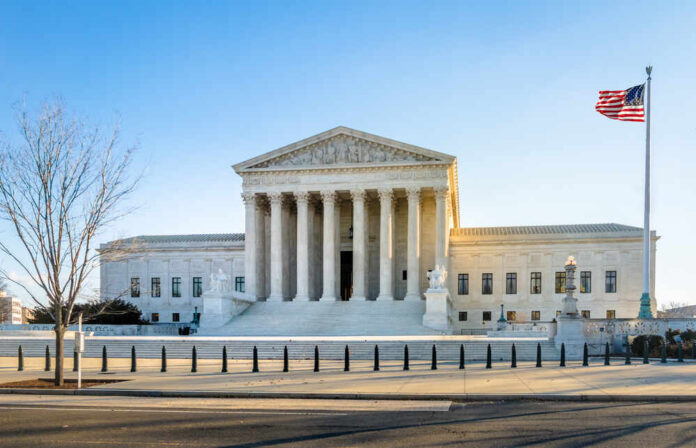
The Supreme Court just cleared the way for bulldozers to roll again in one of America’s most remote and beautiful stretches of border, near Big Bend National Park.
Quick Take
- The Supreme Court issued an unsigned order pausing a lower court injunction that had stopped border wall construction in Texas’ Big Bend region.
- The ruling lets the Trump administration resume building barriers and roads while the underlying lawsuit continues.
- A federal district judge had earlier found the project likely violated limits on executive authority and threatened the area with the lowest illegal crossing rate on the entire border.
- Environmental groups, a river guide, and a historic church preservation group are fighting the project over waived conservation laws.
- Justice Ketanji Brown Jackson was the lone dissenter, signaling the fight over executive power here is far from settled.
What The Supreme Court Actually Decided
The Court’s four-page order did not declare the wall legal forever. It simply paused a district court injunction, letting construction resume while litigation plays out. That distinction matters. The justices gave the administration a green light to build now, but they left the bigger legal question — whether the Department of Homeland Security had the power to waive dozens of laws for this project — unresolved.
🚨🇺🇸 SCOTUS gives Trump GREEN LIGHT to resume TEXAS BORDER PROJECT
The Supreme Court has cleared the resumption of construction on a controversial 500-mile-plus border security project in Texas's Big Bend region. Justice Brown Jackson was the lone dissenter.
Plans include… pic.twitter.com/fVlXjhQCvA
— Mario Nawfal (@MarioNawfal) November 9, 2026
Reuters and other outlets described the order as a win for one of President Trump’s longstanding border priorities, allowing crews to push forward on barriers through a remote stretch of West Texas that includes land inside Big Bend National Park. The administration had argued the injunction was “baseless” and that border-security interests far outweighed any aesthetic or recreational harm raised by challengers.
How The Fight Started With Three Waivers
The dispute traces back to three waivers issued this year by Homeland Security Secretaries Kristi Noem and Markwayne Mullin, starting in February 2026. Those waivers used a 1996 law, Section 102 of the Illegal Immigration Reform and Immigrant Responsibility Act, which lets the Secretary set aside “all legal requirements” to speed up barrier construction in areas of high illegal entry.
The Justice Department argued Congress gave the Secretary sweeping power on purpose, writing in its filing that lawmakers were “hardly shy about the major powers” they handed to Homeland Security. But a federal district judge in Texas, Kathleen Cardone, disagreed. She found the plaintiffs were likely to win their claim that the waivers exceeded the Secretary’s authority under the “major questions doctrine,” a legal principle requiring clear congressional approval for sweeping executive actions.
Why Big Bend Became Ground Zero
Cardone’s ruling pointed to an inconvenient fact for the government: evidence showed Big Bend has the lowest rate of illegal border crossings anywhere along the entire U.S.-Mexico line. That finding fed the plaintiffs’ argument that building a wall there made little security sense and mainly served to bypass environmental review. The Center for Biological Diversity called the waivers the first time the federal government swept aside a broad set of environmental laws inside a national park.
Plaintiffs in the case, including a local river guide and the group Friends of the Ruidosa Church, say construction threatens protected wilderness that supports tourism, ranching, recreation, and historic and spiritual value to nearby communities. Those are real concerns worth weighing. But they don’t erase the fact that Congress wrote a statute giving the executive branch unusually broad waiver authority specifically to speed border construction, a point the administration leaned on hard in its filings.
A Narrow Win, Not A Final Verdict
Justice Ketanji Brown Jackson dissented from the stay, the only justice to do so publicly, which tells readers this isn’t a slam-dunk legal question even among the justices themselves. The stay lets work resume, but it doesn’t settle whether DHS’s waiver power truly covers a remote park corridor with minimal crossing activity, or whether courts can meaningfully review that kind of decision at all.
For now, construction crews have the legal cover to keep working while the case grinds through the courts. Supporters see a president finally able to execute a border security mission Congress funded years ago. Critics see an agency using emergency waivers to dodge environmental law in a national treasure. Both sides agree on one thing: the Supreme Court’s order was about timing, not a final answer, and the real fight over executive authority at the border is still ahead.
Sources:
redstate.com, reuters.com, washingtonexaminer.com, houstonpublicmedia.org, winknews.com, yahoo.com, azcentral.com