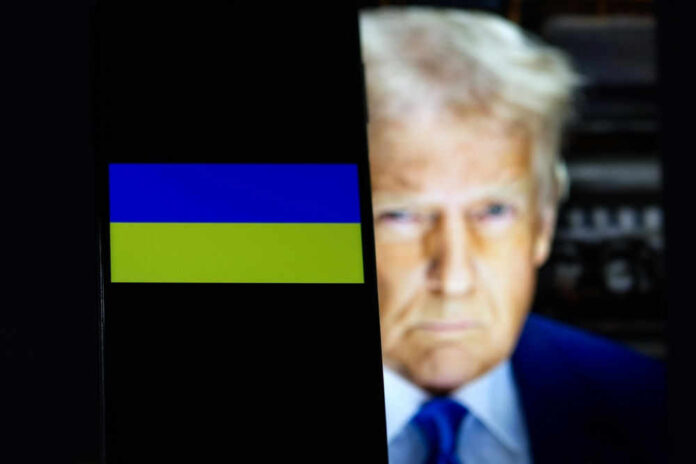
President Trump’s proposed Ukraine peace deal would force Kyiv to give up more territory to Russia, sparking fierce debate over American interests, global security, and the limits of U.S. involvement abroad.
Story Snapshot
- Trump’s plan would require Ukraine to cede parts of eastern territory to Russia, even those not currently occupied by Russian forces.
- The U.S. and Europe would offer Ukraine security guarantees in exchange for territorial concessions.
- The deal faces strong backlash from Ukraine, which views it as a surrender of sovereign land.
- European officials are split between skepticism and growing openness to “security-for-peace” solutions.
Trump’s Peace Proposal Pressures Ukraine to Surrender Land
President Donald Trump’s administration is pushing a controversial proposal to end the war between Ukraine and Russia by demanding Ukraine cede significant portions of its eastern territory.
This plan, according to U.S. officials, includes giving Russia full control of the Donbas region—even areas where Ukrainian forces still maintain a presence.
In addition, the arrangement would see Crimea and Donbas recognized as Russian by the U.S. and others, though Ukraine would not be forced to do so directly. This approach marks a sharp departure from previous U.S. policy, emphasizing rapid conflict resolution and new security arrangements over prolonged military aid or open-ended commitments.
President Donald Trump's plan to end the war between Ukraine and Russia would give the Russians parts of eastern Ukraine they don't occupy, according to a report, citing a U.S. official. MORE: https://t.co/JWIO5t5TlZ pic.twitter.com/BFLWsz1kuo
— NEWSMAX (@NEWSMAX) November 20, 2025
Security Guarantees Offered in Exchange for Territorial Concessions
In exchange for these territorial losses, Ukraine would receive security guarantees from the United States and Europe, aiming to prevent further Russian aggression.
The plan calls for the Donbas to become a demilitarized zone, barring Russian troops from occupying it, while frozen lines of control would be established in Kherson and Zaporizhzhia, with Russia returning limited land.
The Ukrainian military would face restrictions on size and long-range weaponry as part of the broader terms. International actors, including Turkey and Qatar, have participated in drafting the deal, highlighting the global stakes and complexity of any resolution.
Ukrainian and European Resistance to “Land-for-Peace” Framework
Ukrainian President Volodymyr Zelenskyy has steadfastly opposed trading territory for security guarantees, citing his nation’s constitution and the will of the Ukrainian people. In a direct address, Zelenskyy declared that Ukrainians “will not gift their land to the occupier,” rejecting any deals made without Kyiv’s full participation.
Despite the skepticism in Kyiv, some European officials are now reconsidering their positions, shifting toward a “security-for-peace” narrative that focuses less on territorial lines and more on the strength of international guarantees. However, the European Commission has urged the U.S. not to accept a “one-sided” land swap, warning that any agreement must include robust, enforceable security assurances for Ukraine.
American Strategic Interests and Conservative Values
For many American conservatives, Trump’s approach signals a return to prioritizing U.S. interests and constitutional limits over costly foreign entanglements.
The administration argues that Ukraine is likely to lose these territories through continued conflict and that securing a deal now—backed by enforceable guarantees—could prevent endless American involvement and spending.
Critics warn that this could embolden Russia and set a dangerous precedent for international aggression. Supporters counter that the proposal puts the burden of European security on European powers, aligns with American priorities, and reins in globalist ambitions that have historically led to overreach and inflationary spending at home.
Global Reactions and Future Uncertainty
As the world waits for Ukraine’s response, uncertainty dominates. Ukrainian leaders remain deeply cautious, insisting that any agreement be made from a position of strength and with full international backing.
Meanwhile, Russian President Vladimir Putin continues to demand broad territorial concessions as a condition for peace. The U.S. administration has made clear that the “ball is in Zelenskyy’s court,” but the path forward remains fraught with difficult choices and potential consequences for global stability, American interests, and the credibility of Western security guarantees.
The debate highlights the enduring tensions between national sovereignty, principled foreign policy, and the practical realities of geopolitical bargaining in a post-globalist era.