
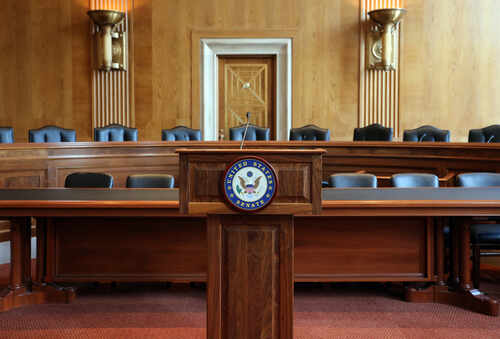
Two Supreme Court justices walked into Congress, asking for millions in security funding, and, for once, the partisan fight in the room was not between them.
Watch the video below this post
Story Snapshot
- Justices Elena Kagan and Amy Coney Barrett made a rare appearance on Capitol Hill to ask for more security funding.
- The Supreme Court wants tens of millions more for personal protection, home security, and a new screening facility.
- Threats against judges and justices have risen for years, driving repeated budget boosts for court security.
- Lower-court judges say they face the same danger but receive far less protection and funding.
When ideological opposites deliver the same warning
Justice Amy Coney Barrett and Justice Elena Kagan did not come to Capitol Hill to debate abortion, guns, or religion. They came to talk about locks, cameras, and bodyguards.
The court is asking Congress for a budget of roughly $228 million, a jump of more than $20 million, with about $14.6 million to expand personal protection for the nine justices through the Supreme Court Police. That means up to six more security agents for each justice, plus better coverage when they travel.
Their appearance was rare by design. Justices usually stay far from the political branches to protect the court’s image. The last time any justice testified like this was 2019. When two of them break that pattern together, it signals that something has crossed a line.
Both liberal and conservative wings now say that threats outside their homes and on their phones are no longer background noise but a daily security problem that needs permanent funding.
What the court wants the money to buy
The justices’ written request is blunt: ongoing threat reviews show “evolving risks that require continuous protection.” The court wants money not just for more agents, but also an off-site command center to monitor home security and speed up emergency responses.
Another $6.5 million would fund the design of a separate screening facility so visitors are checked before they even reach the marble steps, similar to the U.S. Capitol Visitor Center. This is not a fence patch; it is a redesign of how people approach the building.
Justices Amy Coney Barrett and Elena Kagan pleaded for more security funding – saying they face an alarming rise in threats. It comes after police arrested a man they say had a gun and asked for directions to the Supreme Court. Jay O'Brien reports. https://t.co/l4TqTNTlDQ pic.twitter.com/tF2MTliPJ6
— World News Tonight (@ABCWorldNews) July 15, 2026
Separate from the Supreme Court’s own budget, the broader federal judiciary is asking for more than $900 million for security alone, a roughly 3% increase over the previous year. That money covers courthouse protection, threat monitoring, and guard staffing for judges nationwide.
Congress has already shown it is willing to spend when pressure peaks, tacking on an extra $30 million for Supreme Court security in a recent spending deal after court officials made a last-minute plea for more resources.
Why threats against judges keep rising
Threats against federal judges have climbed for more than a decade, tracking the rise of social media and bitter national politics. Court security advocates point to earlier flashpoints like the 2020 attack at a New Jersey judge’s home, where her son was killed, as a turning point that drove bigger security requests.
More recently, protests after the leak and final ruling in the Dobbs abortion case pushed threats to the Supreme Court higher, with marshals and local police deployed around justices’ neighborhoods.
Data from the United States Marshals Service and judicial officials show a steady increase in serious threats that require investigation and sometimes physical intervention. Congress responded by raising the overall court security line by $142 million, a 19% jump, in one shutdown-ending bill.
To many conservatives, this trend confirms a hard truth: when courts rule on hot cultural issues, activists on the fringe stop seeing judges as neutral referees and start treating them like enemy politicians.
The fairness fight: nine justices vs. thousands of judges
There is another side to this story that gets less attention in the headlines. While the Supreme Court receives special funding boosts and new layers of protection, thousands of lower-court judges face similar threats with far fewer resources.
Judicial leaders have asked for extra money to harden courthouse entrances, shield home addresses, and expand protective details, but Congress has not granted the same scale of help outside the high court.
Justices Elena Kagan and Amy Coney Barrett pitched increased security funding for the Supreme Court next year at a pair of rare congressional hearings for sitting justices Tuesday that covered issues ranging from emergency cases to judicial ethics.https://t.co/KBGpgFlXmC
— Roll Call (@rollcall) July 14, 2026
That imbalance raises two questions. First, are we protecting all judges based on risk, or just the nine whose names appear on cable news?
Second, are lawmakers using the symbolism of the Supreme Court to justify big, permanent security expansions that may or may not be tightly managed?
The push for new command centers, visitor complexes, and permanent staffing deserves the same scrutiny as any other federal growth.
Security, accountability, and the line between fear and prudence
No serious evidence shows the court has invented the threat problem; even critics of the spending plans agree that harassment and violence against judges are real and growing. The question is not whether to protect the justices, but how much protection, for how long, and with what oversight.
Some watchdogs note that once a security program grows, it almost never shrinks, even if the original emergency passes.
That is where Congress should do more than rubber-stamp. A responsible path would pair new money with hard reporting rules: detailed threat statistics, audits of how funds get used, and clear triggers to scale security up or down as conditions change.
That approach fits both the duty to protect the people who interpret the Constitution and the conservative instinct to keep large government programs on a short leash. In short, guard the judges—but guard the checkbook too.
Sources:
cnn.com, aol.com, politico.com, news.bloomberglaw.com, cbsnews.com, bostonglobe.com