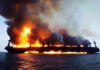
Within hours of the Twin Towers falling, some of New York’s best-known chefs walked away from their stoves and headed straight into the smoke to feed the people digging through the wreckage.
Quick Take
- New York chefs organized meal deliveries to Ground Zero within a day of the September 11 attacks.
- A coalition called Chefs with Spirit used boats to ferry hot food to rescue and recovery workers around the clock.
- Neighborhood restaurants like Nino’s near Ground Zero served hundreds of thousands of free meals over nine months.
- The grassroots effort later merged with the American Red Cross and Salvation Army, which together served millions of meals before the operation ended in May 2002.
Chefs Turned Kitchens Into War Rooms Within Hours
Chef Daniel Boulud saw the towers fall on television and told his staff to start cooking that same day. He mobilized his kitchen to deliver food to frontline workers within hours, then kept it up nearly around the clock for weeks alongside other restaurant owners. It was not a plan drawn up in advance. It was instinct, and it worked.
By September 12, chef Don Pintabona of Tribeca Grill had gathered prominent New York chefs at Chelsea Piers to map out something bigger than any one restaurant could pull off alone.
They needed boats, generators, and volunteers, and they needed all of it fast, because firefighters and police officers were already working through the night with nothing hot to eat.
New York City's restaurant community put together a massive operation that fed Ground Zero workers around the clock for two months after the 9/11 attacks.
Read more: https://t.co/EFTa5BuIiv
— ABC News (@ABC) September 8, 2026
A Boat Became a Floating Restaurant at the Pile
The coalition called itself Chefs with Spirit, and by that Wednesday it had organized regular meal runs to rescue workers at Ground Zero.
Led by restaurateurs Drew Nieporent and Danny Meyer, the group struck a deal with a cruise line to dock a boat behind the wreckage site, turning it into a floating kitchen where chefs like Gray Kunz and Charlie Palmer plated food for exhausted crews.
The operation ran for roughly two months, feeding workers around the clock using boats to cook and deliver meals just steps from the collapsed towers.
Thousands of ordinary New Yorkers pitched in too, hauling supplies, washing dishes, and handing out coffee to anyone who needed it. It was a city feeding its own defenders with whatever it had on hand.
Nino’s and the Neighborhood Restaurants That Never Closed
A mile from Ground Zero, a small restaurant called Nino’s stopped taking reservations and started feeding rescue workers instead.
Owner Nino Vendome and his family turned the place into a nonstop kitchen, and over the next nine months they and an army of volunteers served more than 500,000 hot meals. What began as a plan to feed 150 people a day grew into something no one expected when the doors first reopened.
Chef Bobby Flay, a Manhattan native, spent nine months preparing meals for both families of victims and workers at the site, offering comfort alongside nourishment during one of the hardest stretches the city had ever faced.
Chef Josh Capon, working near Ground Zero at the time, described the days after the attack as chaotic, with his own restaurant forced to close while he pitched in wherever he could help.
How a Grassroots Effort Became an Official Relief Operation
What started as chefs improvising with whatever kitchens they had access to eventually needed real coordination.
The relief effort that restaurants organized in the first week soon came under the official supervision of the American Red Cross, which partnered with the Salvation Army and City Harvest to keep food moving to workers at the site.
That partnership scaled the effort well beyond what any restaurant coalition could manage alone. The Red Cross, with help from roughly 8,000 volunteers, was serving 100,000 meals a day at the peak of the response.
The Salvation Army ran its own parallel effort, called Operation Compassion Under Fire, which continued for nearly nine months and served three million meals before recovery work at the site officially ended on May 30, 2002.
The Scale of a City’s Response
Disaster researchers have long noted that catastrophes like 9/11 draw an enormous wave of unsolicited volunteers before any formal system can absorb them.
One study counted more than 40,000 people showing up at Ground Zero offering to help in whatever way they could. That flood of goodwill is exactly what let chefs, waiters, and home cooks turn ordinary kitchens into relief stations within a day of the attack.
Nine months later, when the last of the wreckage was cleared, the improvised food operation that began with a handful of chefs at Chelsea Piers had grown into one of the largest civilian feeding efforts in modern American history. It started with people who simply refused to stand by while their city burned.
Sources:
abcnews.com, 911memorial.org, cbsnews.com, winespectator.com, bonappetit.com, patch.com, foodrepublic.com, downtownny.com, linkedin.com, udspace.udel.edu, openrepository.aut.ac.nz