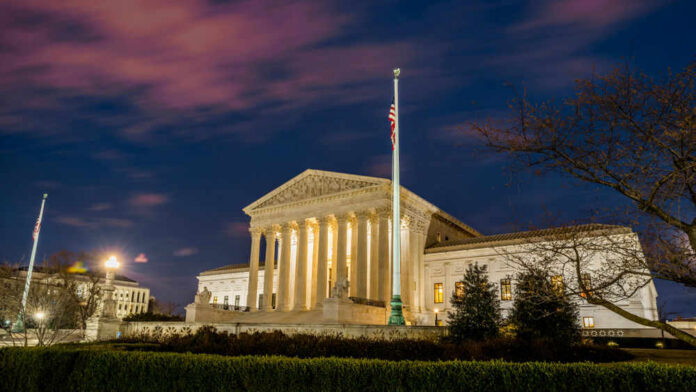
Supreme Court justices publicly clashed in a rare procedural order, exposing deep divisions over race in American elections just as midterms loomed.
Story Snapshot
- Supreme Court fast-tracks Louisiana v. Callais ruling, striking down map with two majority-Black districts as racial gerrymander.
- GOP officials suspend House primaries and rush new map, potentially shifting seats from 5R-2D to 6R-1D.
- Justice Jackson dissents, accusing Court of partisan influence; Alito fires back, calling it baseless.
- Bypasses 32-day mandate delay, thrusting Louisiana into redistricting chaos mid-2026 election cycle.
- Weakens Voting Rights Act, prioritizing Constitution over race-based districts nationwide.
Court Issues Mandate Immediately on May 4, 2026
The U.S. Supreme Court granted challengers’ request in Louisiana v. Callais, issuing its April 29, 2026, 6-3 ruling without the standard 32-day wait.
This affirmed a lower court’s decision that Louisiana’s SB8 map constituted an unconstitutional racial gerrymander under the Equal Protection Clause.
The map included two majority-Black districts despite Black residents comprising about 33% of the population.
Louisiana GOP leaders under Governor Jeff Landry suspended the House primaries scheduled for May, triggering a frantic redistricting before the 2026 midterms.
Challengers, white voters led by Callais, argued for the urgency of preventing unconstitutional elections. The Court adjusted its procedure to enable swift state action, remanding oversight to district courts.
Supreme Court lets Louisiana redistricting ruling take effect immediately, sparking angry words between Alito and Jackson https://t.co/AByfc8QCFe
— CBS News (@CBSNews) May 5, 2026
Timeline Traces Redistricting Wars from 2020 Census
After the 2020 census, Louisiana drew districts without a second majority-Black district. Federal judges ruled in 2022 that this likely violated the Voting Rights Act’s Section 2.
Lawmakers enacted SB8 to comply, adding the district. Republicans challenged SB8 as race-driven, echoing 1993’s Shaw v. Reno barring racial gerrymanders absent narrow tailoring.
The Supreme Court granted certiorari, heard arguments in March 2025, and ruled 6-3 on April 29, 2026. Justice Alito’s majority demanded “strong inference” of intentional dilution, rejecting outcomes tests amid rising Black turnout. Early May saw primary suspensions; May 4 delivered the immediate mandate.
Alito and Jackson Exchange Sharp Words in Order
Justice Ketanji Brown Jackson dissented from the fast-track order, deeming it “unwarranted and unwise.” She charged the Court with stepping beyond the law to shape implementation, risking “appearance of partiality.”
Justice Samuel Alito, author of the majority opinion, rebuked her in a concurrence joined by Thomas and Gorsuch.
He labeled Jackson’s view “baseless and insulting,” stressing the necessity to halt the use of an unconstitutional map. This public judicial spat highlighted ideological rifts: conservatives upheld constitutional primacy; liberals decried procedural meddling. Justice Kagan’s earlier dissent called the ruling an evisceration of VRA Section 2.
Alito grounded the decision in the 15th Amendment’s 1870 text, rejecting race as a factor in districting. Jackson’s procedural critique aligns with liberal fears of GOP advantage, but facts support Alito’s efficiency argument, resonating with conservative values of color-blind governance and election timelines.
Supreme Court lets Louisiana redistricting ruling take effect immediately, sparking angry words between Alito and Jackson https://t.co/AByfc8QCFe
— CBS News (@CBSNews) May 5, 2026
GOP Trifecta Seizes Control Amid Stakeholder Battles
Governor Jeff Landry and the GOP legislature hold redistricting power, eyeing a compact map reducing Black-majority districts to one. This could flip a Democrat seat, bolstering Republican control of the House.
VRA advocates like the NAACP Legal Defense Fund decry dilution of Black voting power. Plaintiffs Callais et al. pushed an expedited mandate; Robinson litigants fought for SB8. Power tilts to state Republicans, empowered by the 6-3 conservative Court majority over federal judges. Ongoing suits contest primary delays, but GOP dominance ensures rapid progress.
Implications Reshape Midterms and VRA Landscape
Short-term chaos disrupts Louisiana voters with delayed primaries and rushed maps. Long-term, heightened VRA burdens—”strong inference” of intent—hinder challenges, favoring Republican maps in Alabama, Tennessee, and Florida.
Black Louisianans face diluted influence; Democrats risk seats. Politically, it shifts the House balance toward the GOP; socially, it curbs race-based remedies.
Conservatives celebrate the prevention of racial districts, aligning with equal protection. Liberals warn of enabled dilution, yet Alito’s textualism upholds constitutional limits over expansive VRA reads, a win for principled restraint.
Sources:
Supreme Court clears way for Louisiana to redistrict ahead of midterms
Supreme Court clears path for Louisiana to gerrymander mid-election
Who is winning the redistricting wars? Not the voters.
[PDF] 24-109 Louisiana v. Callais (04/29/2026) – Supreme Court
Louisiana v. Callais – Legal Defense Fund