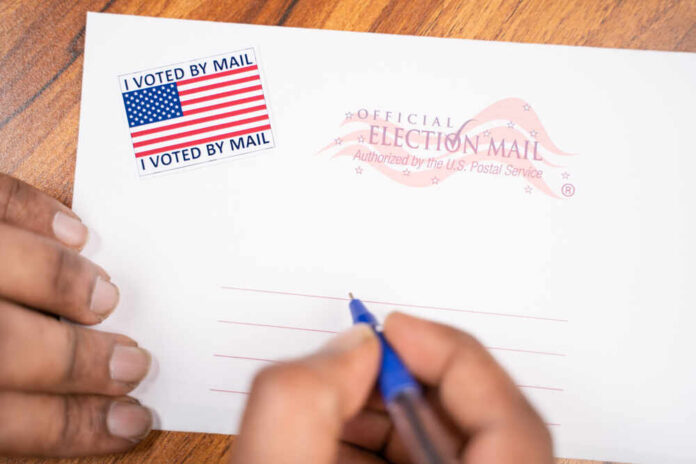
The Supreme Court just told America that a vote cast on time can still count even if the mail runs late—and that simple line in the law may shape every tight race you see from now on.
Story Snapshot
- The Court ruled 5–4 that states may count mailed ballots arriving after Election Day if postmarked on time.
- Justice Amy Coney Barrett said federal Election Day law sets the voting deadline, not the mail delivery deadline.[13]
- Justice Samuel Alito warned the ruling could open the door to fraud and erode trust in close elections.[17]
- The decision blocks a Trump-backed effort to force a single national Election Day receipt cutoff and keep late ballots out.[8][9]
What The Supreme Court Actually Decided, In Plain English
Five justices held that federal law does not stop states from counting mail ballots that arrive after Election Day, as long as the voter got the ballot in the mail by Election Day.
The case, Watson v. Republican National Committee, came out of Mississippi, which allows officials to count absentee ballots that arrive up to 5 business days late if they are postmarked on time.
The decision keeps similar laws in effect in more than half the states and Washington, D.C., many of which use grace periods primarily for military and overseas voters.[8][13]
Justice Amy Coney Barrett wrote that Congress set one national day for when the choice must be made, not a national rule for when envelopes must hit the clerk’s desk. In her view, Election Day statutes say when people must finish voting, not when the post office must finish its job.
As long as a state cuts off new voting on Election Day itself, she said, letting mail-in stragglers come in for a few days does not change the real decision date.[13][17]
Why Trump, The Republican National Committee, And Many Conservatives Are Upset
President Donald Trump and the Republican National Committee tried to use this case to shut down grace periods nationwide. Their argument was simple and blunt: “Election Day” means everything—voting and counting—stops on that day.
Justice Samuel Alito’s dissent put it this way: election day is “a specified date, not a span of multiple days,” and accepting ballots afterward “effectively postpones” when the people truly decide. Many hear that and nod, because a bright, fixed deadline sounds like basic fairness and common sense.[8][9][17]
Trump’s allies also argue that late-arriving ballots create space for mischief. Once campaigns see partial results, they fear activists will “find” votes in friendly areas during those extra days.
So far, though, they have not produced hard evidence of widespread fraud tied to these grace periods, even after dozens of lawsuits in 2020. That gap between fear and evidence is why many courts—and now the Supreme Court majority—have refused to treat every late envelope as suspect on its face.[22]
The Majority’s Logic: Protect On-Time Voters, Especially The Ones You Rarely See
The majority leaned on a simple picture: imagine a Marine voting from overseas who mails his ballot on time, but the plane is delayed. Barrett and four colleagues said that vote is part of the Election Day choice, even if the envelope shows up on Friday.
Their rule is that the voter’s action, not the mail truck’s schedule, decides whether a ballot is timely. That view aligns with federal law that already protects military and overseas voting by mail.[8][13]
Research backs up the claim that many people get caught by hard mail deadlines. One study in Pennsylvania estimated that about eleven thousand voters were effectively shut out because their ballots would have been rejected as late under an Election Day receipt rule.
These are not people who voted twice or cheated. They did what they were told, but the mail lagged. From a small-government perspective, there is a strong case that the state should not discard lawful votes because a federal agency moved slowly.[21]
Election Integrity Fears, Media Spin, And What Conservatives Should Watch Next
Alito warned that stretching counting into the post-election window “risks further undermining Americans’ confidence in election integrity.” He is speaking to a real fracture on the right: many grassroots Americans now assume that anything slow, late, or complicated in vote counting hides something dirty.
Major outlets rushed to frame this ruling as a simple “win for democracy” and an embarrassing defeat for Trump, while treating fraud worries as political theater rather than serious policy concerns. That kind of coverage only deepens distrust.[1][8][17]
The Supreme Court on Monday ruled that states can count late-arriving mailed ballots, rejecting a Trump-led challenge. https://t.co/yCB9tZVfr0
— FOX 13 Seattle (@fox13seattle) June 30, 2026
Here is the nub for conservatives: this decision does not force any state to accept late ballots. It simply says Congress has not banned the practice. Republican-led legislatures remain free to set stricter receipt deadlines, and several have already done so.
The next real battleground will not be the Supreme Court, but statehouses and county election boards. If you care about both security and fairness, focus on three concrete areas: tightening voter rolls, tracking mail ballots precisely, and requiring transparent, real-time reporting of how many late ballots are outstanding.[13][16][24]
Sources:
[1] Web – Supreme Court rules states can count late-arriving mailed ballots, …
[8] YouTube – President Trump disagrees with Supreme Court ruling on mail-in …
[9] Web – Supreme Court rules states can count late-arriving mailed ballots …
[13] YouTube – Supreme Court upholds Mississippi mail-in ballot law
[16] Web – The Supreme Court on Monday upheld a Mississippi law that allows …
[17] Web – How many voters could be affected by earlier mail ballot deadlines …
[21] Web – Election results, 2024: Analysis of rejected ballots – Ballotpedia
[22] Web – Measuring lost votes by mail – PMC – NIH
[24] Web – Millions of ballots are still being processed days after the primary …