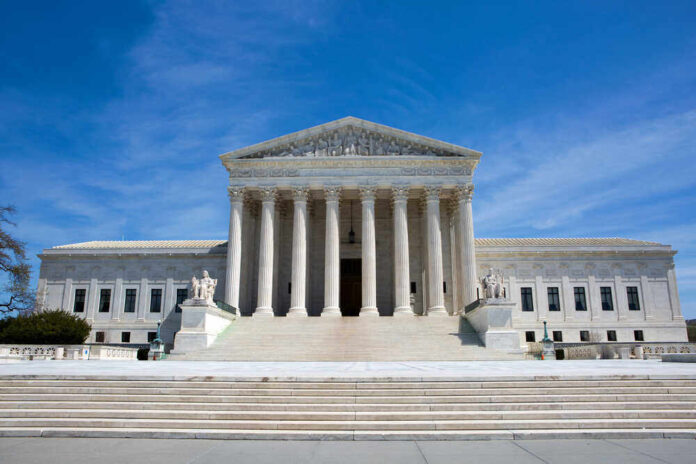
As political tides turn, patriots await the Supreme Court’s decision on whether federal campaign spending limits infringe on free speech.
After decades of unconstitutional restrictions on how political parties can support their candidates, the conservative-majority court will weigh whether current federal caps on campaign spending violate the First Amendment.
The decision could reshape the 2026 midterm landscape and shift power away from unaccountable super PACs.
The Supreme Court announced that it will consider whether Congress can legally restrict the amount of money that political parties can spend in coordination with their candidates.
The case, NRSC v. Federal Elections Commission, centers on limits that the GOP argues violate First Amendment rights and have weakened political parties while empowering outside groups.
Vice President JD Vance, former Representative Steve Chabot (R-OH), and Republican committees initiated the challenge to these decades-old restrictions.
Such restrictions currently limit coordinated spending to between $127,200 and $3,946,100 for Senate races and between $63,600 and $127,200 for House races, depending on the state’s population.
The case gives the Court’s 6-3 conservative majority an opportunity to overturn a 2001 decision that upheld these restrictions.
Justice Clarence Thomas is the only remaining justice from that ruling, making prospects favorable for Republicans seeking to eliminate these government constraints on political speech.
“The government should not restrict a party committee’s support for its own candidates,” said National Republican Congressional Committee Chairman Representative Richard Hudson and National Republican Senatorial Committee Chairman Senator Tim Scott.
“These coordinated expenditure limits violate the First Amendment, and we appreciate the Court’s decision to hear our case,” they added.
In addition, Republicans asserted that subsequent Supreme Court decisions, including the landmark Citizens United ruling in 2010, have already narrowed Congress’s ability to restrict campaign spending.
The current limits have simply shifted influence away from accountable political parties to less transparent super PACs, as evidenced by Elon Musk’s massive $238.5 million contribution to a super PAC supporting Donald Trump.
The Trump administration has taken the unusual step of declining to defend the federal statute, instead siding with Republicans who argue that these limits restrict political parties’ rights to engage in protected political speech.
This prompted Democrat Party committees to intervene in defense of the law, revealing their desire to maintain government control over political speech.
The 6th U.S. Circuit Court of Appeals previously rejected the Republican challenge, with Chief Judge Jeffrey Sutton writing:
“Even when the Supreme Court embraces a new line of reasoning in a given area and even when that reasoning allegedly undercuts the foundation of a decision, it remains the Court’s job, not ours, to overrule it.”
Arguments are expected this fall, with a decision likely next year that could significantly impact the 2026 midterm elections.
The case represents another opportunity for the Supreme Court to restore constitutional freedoms by removing government restrictions on political speech and allowing parties to fully support their candidates without arbitrary limits set by Washington bureaucrats.