The most revealing part of the “self-defense” strikes in southern Iran is not the bombs that fell, but how much Washington expects Americans to take on faith about why they fell in the first place.
Story Snapshot
- U.S. Central Command says it hit Iranian missile launch sites and mine-laying boats “in self-defense.”[1][2][4]
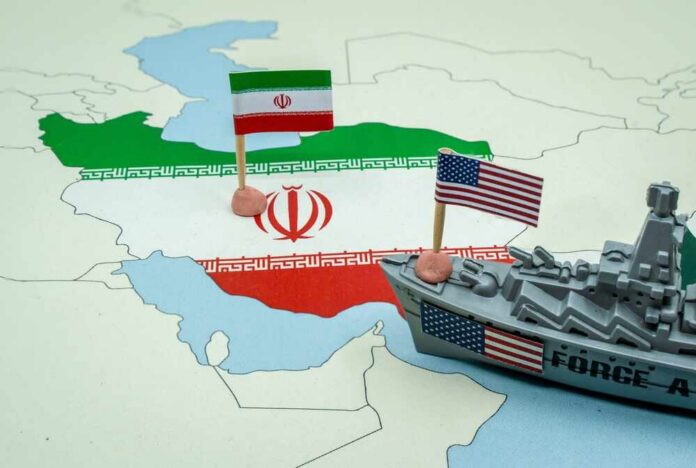
- The strikes unfolded near Bandar Abbas and the Strait of Hormuz during a fragile ceasefire and ongoing negotiations.[1][3][4]
- Public evidence for an “imminent” threat is thin, classified, or simply not shown to the public.[1][2][4]
- The clash exposes a bigger problem: Americans must judge war decisions with almost no hard data, only official claims.[1][4]
Self-defense strikes or carefully branded escalation?
U.S. Central Command publicly framed the operation as a narrow act of self-defense, not a new war.[1][2][4] Its spokesperson said American forces conducted strikes in southern Iran “to protect our troops from threats posed by Iranian forces” and emphasized “restraint” during an ongoing ceasefire.[1][2][3][4] Targets reportedly included missile launch sites and Iranian boats “attempting to emplace” or “place” naval mines near the Strait of Hormuz, the vital oil-chokepoint off Bandar Abbas.[1][2][3][4] That is the official story, and for now, it dominates.
News outlets largely echoed that framing, describing “defensive strikes” on missile positions and vessels “thought to be planting mines” off Iran’s coast.[3][4] Coverage stressed that Iran had not yet responded and that details of the alleged threat remained unclear.[2][4] From a common-sense lens, the goals sound familiar: protect deployed Americans, keep a strategic waterway open, and signal resolve without blowing up a tentative ceasefire. The problem is how little we can actually see behind those carefully chosen phrases.
The evidence gap at the heart of the self-defense claim
Publicly available material does not yet show hard proof that the targeted boats were actively laying mines at the moment they were destroyed.[1][2][4] Reports consistently qualify the claim—boats were “attempting” or “allegedly” preparing naval mines—without providing imagery, intercepted communications, or recovered weapons.[2][3][4]
No casualty or damage report shows an ongoing or recently attempted attack on U.S. forces.[1][2][4] That leaves the entire legal and moral justification hanging on an “imminent threat” assessment the public is asked to trust but not verify.
BREAKING: US military says it carried out ‘self-defense’ strikes in Iran
https://t.co/xCKasilZR9— FOX5 Las Vegas (@FOX5Vegas) May 26, 2026
Self-defense in American law and just-war tradition hinges on imminence and necessity, not convenience or political timing. Yet the record supplied contains no timeline of when the threat was detected, what alternatives were considered, or whether warnings were issued.[1][2][4] That missing detail is not a minor technicality; it is what separates a necessary defensive strike from a preventive or even opportunistic one. When Washington asks citizens to accept “we had to act now” without showing why, it is effectively asking for a blank check.
Ceasefire optics, peace talks, and political risk
The strikes did not occur in a vacuum. They landed during a fragile ceasefire and while negotiators were trying to move a peace deal forward.[1][3][4] Reports explicitly raise uncertainty about how the attacks might affect talks, with some describing the ceasefire as already fragile and violated in smaller ways.[3][4] Iran’s initial silence left the American version untested in the first news cycle, but it also heightened the sense that Washington was prepared to use force even while talking peace.[2][4]
There is nothing inherently wrong with using force during negotiations if American troops face a real, imminent threat. But if the threat is not clearly demonstrated, the strikes look less like reluctant self-defense and more like a calibrated signal—or worse, a habit. That perception matters because every such episode trains adversaries to treat U.S. talk of ceasefires as flexible and trains Americans to shrug at undeclared, open-ended conflict.
Narrative dominance and the Strait of Hormuz problem
The Strait of Hormuz is one of the most sensitive maritime chokepoints on earth, carrying a large share of seaborne oil trade.[2][3] Any hint of mines, missile launches, or closure threats there can rattle markets and pull navies into a confrontation. That strategic reality gives both Washington and Tehran strong incentives to shape the narrative quickly. In this case, U.S. Central Command’s description—self-defense, limited aims, protection of shipping—set the baseline understanding before Iran or neutral parties could offer counter-evidence.[1][2][3][4]
Official secrecy makes that asymmetry worse. Intelligence feeds, drone surveillance video, and legal reviews that could clarify what really happened around Bandar Abbas remain classified by default.[1][2][4]
Skeptics are left with two unappealing options: blindly accept government claims or assume the worst. Neither outcome is healthy for a republic that expects citizens to oversee war powers. Common sense should demand something better: enough declassified evidence to judge whether “self-defense” is a shield for prudence or a slogan for policy drift.
Sources:
[1] YouTube – US Strikes Iran Missile Sites & Boats Amid Shaky Ceasefire …
[2] YouTube – US launches new strikes on Iran, targeting missile sites …
[3] YouTube – US Military Strikes Iranian Boats, Missile Launch Sites
[4] Web – 2025 United States strikes on Iranian nuclear sites