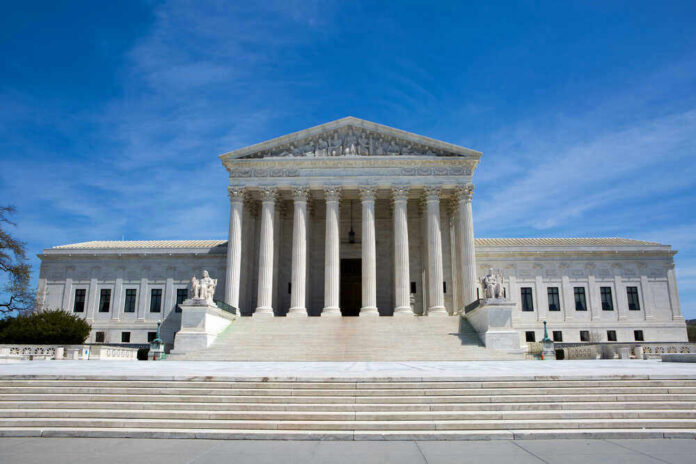
The Supreme Court just gave the Trump administration a sharp immigration win that could matter far beyond one green card holder.
Quick Take
- The Court ruled 6-3 for the administration in a case involving lawful permanent resident Muk Choi Lau and a 2012 parole decision.[1]
- Justice Clarence Thomas wrote that border officers did not need clear and convincing evidence before treating Lau as an applicant for admission.[5][6]
- The ruling leaves one major question open: whether Lau’s offense counts as a crime involving moral turpitude.[6]
- The decision fits a wider pattern of judicial deference to executive power in immigration cases.[7]
What the Court Actually Decided
The case turned on a 2012 decision by immigration officers to place Lau on parole after he returned from China because he had been accused of counterfeiting.[1][5] Lau argued that the officer went too far and gave the government an easier path to removal.
The Supreme Court rejected that claim and sided with the Trump administration, which argued that suspicion of a crime can be enough to trigger parole treatment for a returning green card holder.[1][5]
Supreme Court sides with Trump admin in green card holders immigration case https://t.co/qQtteQfX2Z pic.twitter.com/XN5A5FAncj
— New York Post (@nypost) June 23, 2026
Justice Thomas’s majority opinion said Congress did not require border officers to prove their case by clear and convincing evidence before making that call.[6] That matters because it removes a higher proof burden that lower courts had been willing to impose. The Court did not decide whether Lau’s counterfeiting-related conduct qualifies as a crime involving moral turpitude, so the legal fight is not fully over.[6]
Why Supporters Call It a Major Victory
Supporters of the ruling see it as a clean answer to a basic question: how much proof must the government have before it acts at the border? Federal attorneys urged the Court to take a broad view of executive power over immigration, and the Court accepted that view in this case.[1][5] That is why the decision was quickly framed as a win for tougher screening of green card holders accused of crimes.
The Associated Press reporting also notes that the Trump administration argued mere suspicion of criminal activity is enough to place a lawful permanent resident on immigration parole.[1][5]
In plain terms, the administration wanted more room to act first and sort out the facts later. For people who favor strict border enforcement, that logic sounds like common sense. For critics, it sounds like too much power with too little check.
Why Critics See a Bigger Warning Sign
Justice Ketanji Brown Jackson dissented and warned that Lau was pushed into “immigration limbo” before any conviction.[1] That dissent gives opponents a strong talking point, because it frames the case as punishment before final proof. The ruling also lands in a legal climate where the Supreme Court has often deferred to immigration authorities rather than courts, which adds to the sense that executive power is moving forward while judicial restraint is pulling back.[7]
Do you understand how important this ruling is?
This just massively sped up the “process” of deportation.
“A federal appeals court handed President Donald Trump a significant win in his mass deportation efforts with a ruling Tuesday reviving his administration’s move to speed…
— JoeLange (@JoeLange) June 23, 2026
The same tension shows up in the public reaction. Some immigration advocates say the ruling creates a broader path for revoking green cards, while supporters say it simply lets officers do their jobs.[2] That split is not just political theater.
It is the real fight over this case: whether the Court protected order at the border or lowered the guardrail around lawful permanent residents who have not yet been convicted.
The Bigger Immigration Pattern
This decision does not stand alone. The broader Supreme Court record, as summarized in the Court case listings on immigration and national security, shows repeated deference to legislative and executive choices in this area.[7]
That pattern helps explain why the administration pushed this case so hard. If the Court accepts a broad reading here, it signals that immigration officials may get wide latitude whenever they say they need quick action.
There is also a practical reason the case will keep drawing attention. Green card holders often think lawful permanent residence gives them strong protection. This ruling shows that protection is not absolute when the government says a returning resident may have committed a serious offense.[1][6] That is the part most people will remember, even if the finer legal question remains unresolved in lower courts.
Sources:
[1] Web – Immigration case dealing with green card holders, Supreme Court sides …
[2] Web – Supreme Court sides with Trump administration in immigration case …
[5] Web – The Supreme Court unanimously ruled that the Department of …
[6] Web – Cases – Permanent residence – Oyez
[7] Web – Immigration & National Security Supreme Court Cases