
Iran’s embassy told two named U.S. Navy officers “We will find you” the same day their destroyer returned home.
At a Glance
- Iran’s embassy in South Africa posted “We will find you” with photos naming two USS Spruance officers.
- USS Spruance launched Tomahawk missiles at Iranian military targets during a yearlong combat deployment.
- The Navy identified Cmdr. Leigh R. Tate as commanding officer and described his ship’s combat role.
- The destroyer shot down drones and missiles and engaged an Iranian cargo ship that challenged a blockade.
Iran’s Embassy Names Two Officers And Issues A Threat
The Iranian embassy in South Africa posted the words “We will find you” on X with images that named Cmdr. Leigh R. Tate and Lt. Cmdr. Jeffrey E. York the day USS Spruance returned to San Diego. The post identified them as the ship’s commanding officer and executive officer. The language and timing sent a clear message meant to intimidate specific U.S. service members by name.
Iran is threatening to track down two U.S. Navy officers just one day after President Trump warned Tehran against assassinating senior American officials.
"We will find you," Iran's embassy in South Africa posts, identifying the commander and executive officer of the USS… pic.twitter.com/NdvxO8kfl2
— Fox News (@FoxNews) November 16, 2026
Media outlets across the spectrum framed the embassy’s message as a direct threat against U.S. personnel. The attention focused on the naming of two officers rather than a general political claim. That tactic matches a long pattern in which Tehran mixes public warnings with pressure campaigns aimed at individuals. U.S. reporting in recent years has tracked Iranian-linked plots or threats toward American officials and military members worldwide.
What Spruance Did During Its Combat Tour
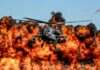
The Navy reported that USS Spruance launched dozens of Tomahawk Land-Attack Cruise Missiles against Iranian military targets between February and August 2026. The destroyer also helped fire some of the opening strikes of Operation Epic Fury on February 28. Beyond long-range strikes, the ship defended U.S. forces by shooting down 12 unmanned aerial vehicles and four anti-ship cruise missiles during the same deployment.
Spruance’s crew also used the ship’s 5-inch gun to fire on the Iranian cargo ship M/V Touska after it attempted to run a U.S. blockade, according to Navy-related reporting. These engagements placed the crew under sustained pressure in contested waters. The actions match the destroyer’s mission: protect the carrier and the fleet, strike lawful military targets when ordered, and keep sea lanes controlled against hostile threats.
Who The Officers Are And What Roles They Held
The Navy identified Cmdr. Leigh R. Tate as Spruance’s commanding officer upon the ship’s return and highlighted his public comments. Tate said the crew faced intense combat and that the destroyer helped shield the carrier and the broader force from incoming drones and guided missiles. He declined to discuss targeting specifics for operational security, which is standard practice in wartime reporting.
The embassy’s post also named Lt. Cmdr. Jeffrey E. York as executive officer. That role oversees ship readiness and supports combat operations but does not by itself prove who ordered any specific strike. The public record ties both men to leadership on Spruance during combat. It does not assign personal launch authority for particular missiles. That distinction matters for legal and moral claims about individual accountability.
Why The Threat Matters, And How To Judge It
The embassy’s message weaponized social media to single out two Americans tied to a warship that clearly fought Iranian forces and assets. The facts show Spruance used force, struck military targets, and defended the fleet in combat. That is the job of a U.S. warship in a declared operation. Targeting named officers online for that service crosses from debate into doxxing and intimidation. It also aims to chill lawful military duty through fear, which Americans should reject on principle.
American common sense aligns with basic law-of-war rules: combatants may attack opposing combatants, not civilians. The United States trains commanders to reduce civilian harm and to make decisions based on the information available at the time, not on hindsight alone. Threats to hunt down individuals on social media do not meet any standard of justice; they are pressure tactics, not accountability. The right forum for any claim is evidence and law, not a tweet.
Sources:
redstate.com, foxnews.com, the-express.com, newsfinale.com, globalsecurity.org, whmi.com, warwick.ac.uk