
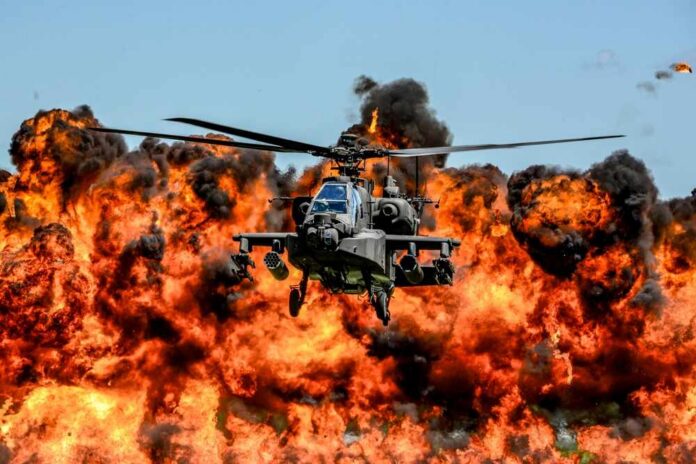
A state police helicopter circled a truck of kids, then a single round shattered a family forever.
Story Snapshot
- The mother says a Tamaulipas state helicopter fired the shot that killed 7-year-old Aranza.
- State investigators reviewed witness accounts, video, and ballistics to trace the fatal round.
- Reports say the projectile matched weapons used by State Guard personnel on the aircraft.
- Security officials say the helicopter took ground fire and returned fire during the operation.
What Happened On The Road In Matamoros
Claudia Pardo García drove her family through Matamoros on October 29 during a security operation. She says a state police helicopter descended, circled twice, and opened fire. Her 7-year-old daughter, Aranza, took a bullet to the head. Pardo says she was also shot in the leg. She told The Associated Press the gunfire came from above, and investigators later interviewed her as a key witness. State media accounts placed cartel roadblocks and gunfire in the city that afternoon.
Tamaulipas state investigators began an official review. Prosecutor Jesús Govea said his team took statements from Pardo and other witnesses and analyzed video and ballistics to identify who fired the fatal shot. Reporting that cites the Attorney General’s Office says testing linked the projectile to a weapon carried by State Guard officers aboard the helicopter. Separate coverage described the round as 7.62 millimeters, consistent with rifle fire from state weapons used in aircraft operations.
What Authorities Acknowledge And What They Dispute
The state’s Public Security Department acknowledged one of its helicopters flew a reconnaissance mission during the operation. Officials said the aircraft came under fire from the ground and that officers returned fire. The state security secretary offered condolences and attributed the death to violence during the operation, not an intentional attack on the family. Reports say three State Guard crew members from the helicopter are under investigation, but none has been publicly named as the shooter.
This official account does not erase the mother’s claim. It frames the shot as a mistaken response. That matters, but the core question remains simple and hard: whose bullet killed the child? The prosecutor’s office, according to reports, points to weapons carried by state personnel. That aligns with common sense guardrails many Americans expect: do not fire from a helicopter into traffic unless you can clearly identify a hostile target and a safe backstop.
The Ballistics Trail And The Flight From Above
Coverage that summarized an El País review described a 7.62 millimeter projectile traveling on a downward path, which matches fire from an aircraft. That trajectory supports the mother’s account that the shot came from above. The public has not seen the full lab report, chain of custody, or a match to the weapon’s serial number. But the described evidence points in one direction, and state officials have not produced a rival ballistic trail to a cartel weapon.
NEW CASE — Matamoros, Mexico: 7-year-old U.S. girl Aranza Aidelany Pardo was killed Oct. 29 when Tamaulipas state police fired from a helicopter at her family's vehicle during a cartel operation. Her mother and 13-year-old brother were also shot. https://t.co/DxKTvbz7Ej
— 2nd amendment (@ProfiloCases) November 10, 2026
The case’s weakness is narrow but real: authorities have not identified the individual finger that pulled the trigger. That gap matters for criminal charges. It does not change the duty question. When the state deploys aerial firepower over a city street, it assumes the burden to avoid killing children. The state says it faced ground fire. If so, the standard for restraint goes up, not down. Fire discipline from the sky is not optional; it is the job.
Why This Case Resonates Beyond One Border City
Families in Mexico often confront a wall when security forces kill civilians. Reports by the United States government and human rights groups describe long delays, few prosecutions, and a pattern of officials calling civilian deaths collateral damage from firefights. Many cases involve police or military firing on vehicles. Those patterns explain why this mother demands full disclosure: flight logs, video, radio traffic, and the complete ballistic file should be public when a child dies.
What Accountability Would Look Like Now
Real accountability would identify which crew member fired, match that shot to a specific weapon, and release the evidence. It would also set a plain rule: no aerial fire without visual certainty, identification, and a safe backdrop. The state can keep the public safer and protect its own officers by tightening these controls, not by hiding them. Justice starts with facts on the table and ends with consequences that fit those facts, without fear or favor.
Sources:
foxnews.com, mezha.net, proceso.com.mx, cbsnews.com, apnews.com