Republicans launched a first-ever midterm convention in Dallas to turn a scattered election map into one loud, national drumbeat.
Story Snapshot
- President Trump announced and headlined the first Republican midterm convention in modern history.
- The Republican National Committee set Dallas’s American Airlines Center for September 9–10, with public tickets.
- Vice President JD Vance joined as a keynote; roughly 100 candidates were expected, according to broadcast reports.
- Organizers said the goal was to rally voters and help hold congressional majorities.
A National Midterm, By Design
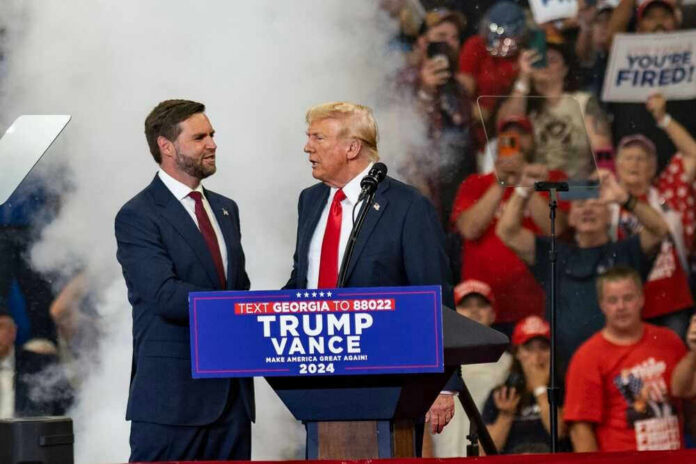
President Trump announced a new kind of Republican gathering and put it in Texas. The Republican National Committee said this Midterm Convention would highlight Trump’s record and the America First agenda, with the party presenting it as the first of its kind in modern American history.
Dallas’s American Airlines Center locked the dates as September 9 and 10, turning a basketball arena into a two-night political stage with public access and ticketing to scale the crowd and the message.
The final midterm push is beginning with something Republicans have never tried before.
GOP leaders and candidates are gathering in Dallas for the party's first national midterm convention, putting President Donald Trump at the center of a two-day event designed to energize… pic.twitter.com/pFpo8NtH0G
— Fox News (@FoxNews) September 9, 2026
Reuters described the strategy plainly: Republicans would kick off a first-ever midterm convention to help the party hold congressional majorities. This reframes an off-year cycle as a made-for-television event with a single narrator.
Trump and Vice President JD Vance were billed as keynote anchors across both nights. That lineup signaled the core pitch: national stakes, national leaders, national energy, all focused on turnout and down-ballot lift.
What Will Happen On Stage
The program aimed to blend rally energy with party branding. The Republican National Committee said the event would showcase accomplishments and a forward agenda tied to border security, inflation, and crime, themes central to America First messaging.
Party materials called it the largest convention in 10 years and promised broader access with public tickets, implying a mass-participation feel rather than a closed-door summit. That format suits a media era where a strong clip can carry farther than a long memo.
Broadcast reporting pointed to significant candidate presence. ABC News said roughly 100 candidates and House members were expected during the two-day run, reinforcing the idea that this was a campaign engine, not just a tribute show.
Reuters’ scheduling notes confirmed the where and when, while ABC detailed the speaker cadence: Trump on opening and closing, Vance on night two. Exact rosters can shift close to showtime, but the marquee was set to keep the spotlight bright.
Why Dallas, Why Now
Midterms punish incumbents more often than not, which explains the experiment. Parties try to centralize attention when they believe unity and discipline can beat the usual midterm gravity.
The Republican bet is simple: a single, high-energy event can boost fundraising, field signups, and message focus across dozens of districts at once. Reuters framed the logic as a rescue mission as much as a rally, designed to harden the base and steady the map.
Dallas offers scale, media markets, and symbolism. Texas is reliable red at the statewide level and sits near battleground House races. The American Airlines Center gives camera-friendly shots and production control.
Public tickets extend the reach beyond donors and insiders. That matters for viral spread. A broad room delivers more applause lines, more cutaways, and more moments that digital teams can push to voters who never step inside an arena.
Attendance Gaps And The Optics Game
ABC News reported that some notable Republicans planned to skip, even as the headliners locked in. That matters for cameras, but it matters more for narrative.
The party can still claim momentum if the crowd is full, the program is tight, and the news cycle carries the central themes. The opposite is also true: empty seats and mixed signals can eclipse the planned message.
The first-mover risk is real but manageable. The Republican National Committee set expectations sky-high with “historic” language and promises of scale. That is a double-edged sword. If the arena rocks and small-dollar donations spike, Republicans prove a new tool works.
If not, critics will call it a spectacle. Common sense says judge it by practical metrics: candidate coordination, cash raised, volunteer growth, and whether close districts move an inch in the right direction.
Sources:
abcnews.com, reuters.com, rmb.reuters.com, gop.com