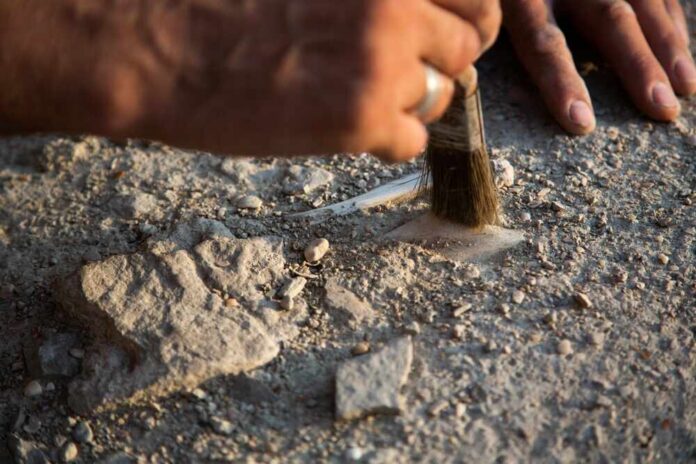
Teams on Turkey’s Ararat flank just pulled nearly a thousand soil samples and pottery shards from the ground—and the old Noah’s Ark debate suddenly feels new again.
Story Snapshot
- Researchers expanded digs at the Durupınar site near Mount Ararat.
- Almost 1,000 soil samples and new pottery finds fuel fresh analysis.
- Lab work focuses on soil chemistry and age ranges of materials.
- Turkish and international teams secured permits and shared early data.
Excavations Move From Hype To Hands-On Sampling
Researchers intensified fieldwork at Durupınar, a boat-shaped formation near Mount Ararat in eastern Turkey. The team reported collecting close to 1,000 soil samples for lab testing, a scale-up from earlier campaigns that gathered dozens of cores and grab samples for university labs in Ankara and Istanbul.
The group includes Turkish academics and the Noah’s Ark Scans initiative, which has highlighted chemical contrasts between soil inside and outside the outline. Officials granted permits to expand work at the site under archaeologist Cenker Atila.
Sampling plays a central role because clear, layered artifacts and structure would settle the question fast. Prior surveys emphasized soil chemistry differences and subsurface scans. The new phase aims to pin down dates, contents, and formation processes with more precision.
Teams shipped the bulk samples to Turkish labs for winter analysis. Reported measures under review include carbon content, potassium levels, and acidity, alongside mineral signatures that could mark water-driven deposition or human activity during known periods.
Noah’s Ark Mystery Deepens as New Discoveries Emerge Near Mount Ararathttps://t.co/yG9OGhBGyS
— Arkeonews (@ArkeoNews) September 23, 2026
Pottery Shards Anchor A Human Timeline In The Area
Crews reported pottery fragments near, but outside, the formation. Public statements linked some pieces to the Chalcolithic and Iron Age timeframes, suggesting people moved through the zone thousands of years ago.
Coverage in Israeli and British outlets described shards exposed during nearby road work and small digs, with date ranges often placed broadly between about 5500 and 3000 before Christ for earlier material, and later first-millennium layers for others.
Turkish and international write-ups also cite earlier lab reports of “clay-like materials” and “marine deposits,” including mollusk remains, from prior sample sets analyzed at Istanbul Technical University.
Those analyses suggested dates roughly 3,500 to 5,000 years old for some materials, lining up with known prehistoric periods in Anatolia.
As with many mountain sites, colluvial movement and slope wash can mix layers, so the larger sample count is meant to strengthen the signal against that natural noise.
What The New Soil Push Seeks To Prove
Chemistry is carrying much of the load. Advocates point to higher organic matter, lower pH, and more potassium inside the outline compared with soil just outside it, which some tie to decayed wood and ash.
The latest field campaign aims to test whether these contrasts repeat across many new points and whether they stop cleanly at the shape’s edges. If the contrasts persist across hundreds of samples, the team argues the case for unusual, localized inputs grows stronger.
Scale matters here. Earlier work often leaned on a few dozen cores or handheld tests. A haul near one thousand samples, if well logged, georeferenced, and stratigraphically sound, can cut through chance variation.
The best outcome for proponents would be a consistent chemical step-change at the outline boundary, paired with artifacts in sealed layers. That type of pattern is rare in natural slope features and would push the discussion beyond repeats of past claims.
Why This Story Keeps Returning
Durupınar has drawn attention for decades because it looks like a ship in plan view. Popularizers have often run ahead of the evidence. Mainstream archaeologists and geologists have pushed back, saying erosion can carve such shapes and that strong claims require direct, layered, and reproducible proof.
That broader pattern has defined “biblical archaeology” flashpoints for years: bold identification first, then a long process of testing against basic field standards.
🔥🔥 Noah's Ark 🔥🔥
After 70 years, Researchers with @noahsarkscans have secured permits and begun core drilling at the Durupinar site near Mount Ararat in eastern Turkey.
Genesis 8:4: "And the ark rested in the seventh month, on the seventeenth day of the month, upon the… pic.twitter.com/tagKOCgrbi
— KJofTikTok (@TheKJofTikTok) September 23, 2026
If pottery sits in intact layers tied to a structure, that will stand up. If chemistry keeps showing sharp edges at the outline across hundreds of points, that will stand up too. And if the site is a natural ridge with scattered human debris nearby, that conclusion will also be clear once the data speak.
Sources:
metro.co.uk, dailymail.com, jpost.com, noahsarkscans.com, x.com, intercom.help, academia.edu