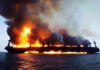
Twenty people died and five are missing after a foreign cargo ship caught fire during repairs at a Qingdao shipyard, turning routine maintenance into a mass-casualty disaster.
Story Snapshot
- The blaze erupted around 11:15 a.m. during maintenance at a state-owned shipyard.
- Authorities reported 20 dead, five missing, and multiple injured; 12 evacuated.
- State media identified the vessel as a foreign-flagged cargo ship under repair.
- China’s leadership ordered a full search and rescue and accident-prevention measures.
A flash fire in a high-risk window
Local authorities said the fire broke out on a foreign cargo ship at China State Shipbuilding Corporation’s Qingdao Beihai Shipbuilding Co., Ltd., a major yard on the Yellow Sea coast, at about 11:15 a.m. Thursday. State media reported 20 confirmed dead and five still missing.
Photos and tracking details shared by outlets identified the ship as a Liberian-flagged cargo vessel, known as Ocean Melody in some reports, undergoing repairs at the time. Rescue teams evacuated 12 people and treated several injuries.
At least 20 people killed in a fire aboard a cargo ship in China’s Qingdao
The vessel was undergoing repairs at the port. Rescue operations are still underway. pic.twitter.com/2akHwh55hM
— NEXTA (@nexta_tv) September 10, 2026
Maintenance periods are the most dangerous hours a ship will ever see. Fire detection lines may be isolated. Tanks and holds may be open. Contractors swarm confined spaces. Cutting torches, welding arcs, and grinding wheels throw sparks. That mix turns a small error into a runaway event.
The United States Occupational Safety and Health Administration warns that ship repair workers face a high risk of fire and explosion and requires strict hot-work controls to cut that risk.
What officials said and did next
Chinese state outlets said emergency services mounted search and rescue and worked to cool hot spots across the hull. The reports described an all-hands push to find the missing.
National leadership called for full efforts to prevent further major accidents and to account for the cause and lessons once the fire is out.
These are standard steps after a deadly maritime incident, but the casualty toll signals unusual speed and spread of the fire before teams could escape or isolate it.
Media accounts converged on key facts: the location, the death toll, the missing count, and that the ship was foreign-flagged and undergoing repairs at the Qingdao Beihai yard.
Early numbers can shift as responders search compartments, yet the core sequence—maintenance, ignition, mass casualties—lines up across official and international reports.
Why repair fires kill fast
Hot work on steel near coatings, fuel residues, or cargo dust can light fires that travel unseen inside stiffeners and voids. Investigators worldwide have traced ship fires to smoldering embers from earlier hot work, ignition of epoxy coatings, and failures to test air and gas conditions before cutting resumes.
Safety guidance stresses gas-free certificates, watch-standers during and after hot work, and firefighting gear staged within arm’s reach, not a deck away. When those layers falter, escape routes vanish in minutes.
20 people were killed, and five remain missing after a fire broke out on the Liberia-flagged cargo ship Ocean Melody at a Qingdao shipyard in China. Check details here.
Read here :https://t.co/wGpN6CsvFW#China #Qingdao #ShipFire #XiJinping #DNAUpdates pic.twitter.com/LiFa7A8XqS
— DNA (@dna) September 10, 2026
Accident boards often take weeks to pinpoint the trigger. Past cases show a familiar shortlist: a stray spark, a missed gas reading, a disabled detector, or a maintenance shortcut that saved minutes and cost lives.
Leaders should insist on them every shift, not only after a tragedy. If hot work was involved, the questions are simple: who signed the permit, who held the watch, and were spaces truly safe to enter?
What to watch as the facts harden
Expect officials to confirm the ship’s identity, the final casualty count, and the ignition source once inspections are done. Watch for details on whether fire detection or suppression systems were offline for maintenance, how long the fire watch lasted after hot work, and whether contractors and crew drilled together before cutting began.
These factors separate a close call from a mass-casualty event. The best investigations name the lapse and the fix so the next yard does not repeat this day’s script.
Sources:
nbcnews.com, cbc.ca, news.cgtn.com, english.news.cn, english.ahram.org.eg, newsbytesapp.com, osha.gov, sigtto.org, maritimesafetyinnovationlab.org, tal.sg, ntsb.gov