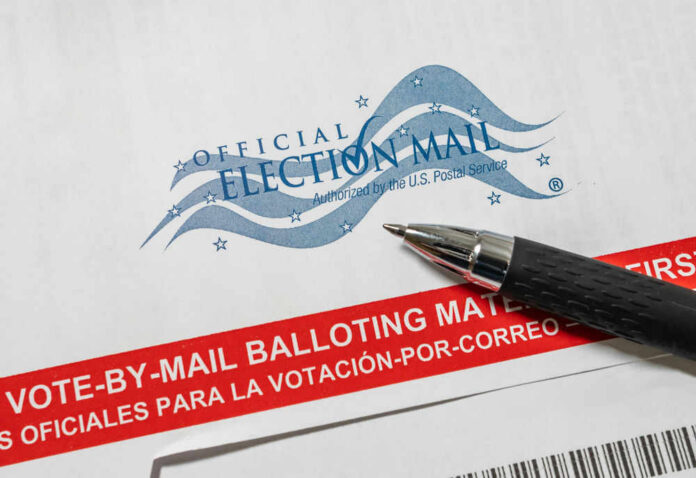
USPS just told states it will not move their federal election ballots unless each envelope carries a unique barcode tied to a named voter in a federal portal.
Story Snapshot
- USPS posted ballot-mail rules that hinge on serialized barcodes and a federal portal.
- States would submit voter names, addresses, and barcode data for mailed ballots.
- USPS says this boosts compliance checks and helps law enforcement if needed.
- Court action will decide if these rules take effect before voters ever see them.
What USPS Actually Put On The Table
The United States Postal Service moved beyond tips and best practices and drafted hard rules for federal election mail. The plan requires states to enroll in a Federal Ballot Mail Portal.
States would upload each intended ballot recipient’s name and address, plus the unique barcode linked to that voter’s outbound and return envelopes, before USPS accepts the mail for processing. The agency frames this as an accountability upgrade that adds traceability to every ballot as it moves through the mail stream.
The United States Postal Service has released a new rule adding verification requirements to all mail-in ballots. https://t.co/How6zwugny
— ABC News (@ABC) August 23, 2026
These rules build on long-standing postal standards that already govern how election mail should look and move. USPS Publication 632 has, for years, told officials how to design envelopes, place logos, and plan timelines so ballots can sail through automation systems.
The change is not about stamps and logos. It is about tying every ballot envelope to a named person with a serialized barcode and lodging that data in a federal system for pre-mail acceptance checks.
How The Barcode Gate Works
The barcode is the quiet bouncer at the door. It links a ballot envelope to the voter record states upload. USPS would verify outbound ballot mailings against that list before entering them into the mail stream.
The agency argues this lets it detect mismatches, watch flows in real time, and document custody for audits. Reuters reported USPS’ view that unique barcodes will help determine adherence to federal law and aid law enforcement when issues arise.
Supporters say this answers a simple question that keeps trust afloat: who sent what, to whom, and when? A coalition of state attorneys general backed the proposal, citing standardized envelopes and unique barcodes to track ballots as tools to reduce weak spots in the chain of custody.
Pushback From States And Privacy Worries
Opponents see a different picture. They argue the rule shifts USPS from carrier to gatekeeper by conditioning ballot entry on a federal list and serial codes.
A multi-state letter said that states would have to provide USPS with each voter’s name, address, and the unique codes for outbound and return envelopes, which USPS would use to verify mailings before acceptance. Critics warn that centralizing those data in a federal portal raises privacy questions and strains federalism principles.
The USPS Published its Mail-In-Ballot Rules For the Midterm Elections…This is HUGE.
The USPS just published a new rule implementing Trump’s executive order on mail-in ballots.
States that want the Postal Service to handle their mail-in or absentee ballots must now:
-Turn… pic.twitter.com/EuVuak4Stk
— Americaforever (@onetexgal9) August 23, 2026
State officials also say the clock is brutal. Ballot design, printing, and mail schedules leave little room to retool systems, build new data pipes, and pass design reviews. It was reported that the portal upload and barcode linkage would be required before ballots are mailed, a sequence that can jam tight calendars.
Some election experts add that registration checks, voter eligibility confirmation, and signature or identification verification already exist, so the incremental gain from a new postal gate may be modest.
What Happens Next, And Why It Matters
The legal lane is not clear. USPS posted a final rule but said it will not implement it unless a court lifts an injunction. Reuters noted the agency intends to publish in the Federal Register and then stand down pending court guidance. That posture creates a paradox.
The standards now exist on paper, setting expectations for states and vendors. But their real-world effect hinges on judges and briefing schedules that do not care about print deadlines.
The core tradeoff is easy to grasp and hard to escape. More visibility means tighter control and better audits. More visibility also means more data sharing, more bureaucracy, and a stronger federal hand. Those who prize both election integrity and limited federal reach face a line-drawing choice.
On balance, tying envelopes to real voters with traceable codes is sound logistics. The open question is whether USPS, not Congress or state law, should flip the switch that decides what ballots the mail will carry.
Bottom Line For Voters And Officials
Voters will not notice barcodes if the system works; they will notice delays if it does not. Election officials should inventory what they already track, what their printers can encode, and what their case management systems can export.
They should also insist on clear data retention rules, access controls, and audit trails before uploading a single name. USPS has delivered elections for generations under public, posted standards. If the agency wants a new role, the burden is to prove it improves trust without grabbing the steering wheel.
Sources:
reuters.com, grayhairsoftware.com, about.usps.com, nul.org, content.govdelivery.com, integritypress.org