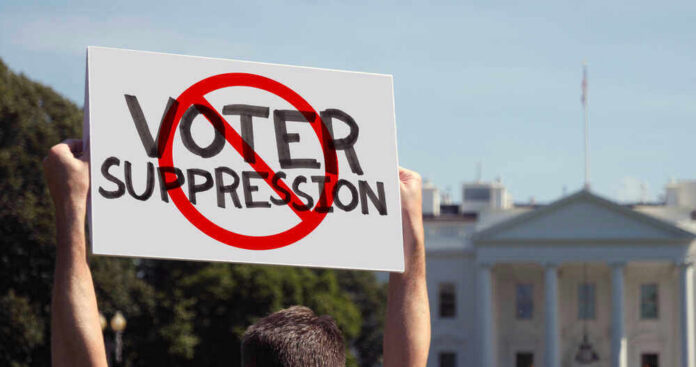
A little-known redistricting fight in Alabama has turned into a test of whether federal judges or elected legislators will decide how far race and party can be used to lock in power in Congress.
Story Snapshot
- Federal judges blocked Alabama’s Republican-drawn congressional map as an illegal dilution of Black voting power under the Voting Rights Act.
- The court ordered a map with two districts where Black voters have a real opportunity to elect candidates of their choice.
- Alabama Republicans argued Washington and liberal lawyers were forcing a race-based map on the state.
- The U.S. Supreme Court later let Alabama use a one–Black-district map for an election cycle, triggering a new round of legal and political fire.
Why Alabama’s Map Became a National Flashpoint
Alabama’s fight over its congressional lines did not start as a cable-news drama; it began with a familiar story in the South: a majority-Republican legislature drew a map with just one majority-Black district in a state that is about one-quarter Black.[1] Civil rights groups and Black voters sued, arguing the map “cracked” Black communities across multiple districts so their votes could not reliably elect anyone they preferred.[1] Under Section 2 of the Voting Rights Act, that kind of dilution is exactly what Congress told courts to police.
A three-judge federal panel—two appointed by Republican presidents, one by a Democrat—heard the evidence and unanimously ruled that Alabama’s map violated the Voting Rights Act.[1] The judges blocked the map and ordered lawmakers to draw a new plan with two districts where Black voters had a genuine opportunity to elect their candidates, not just be numbers on a demographic spreadsheet.[1][2] That is a significant remedy: it effectively takes one safe Republican seat and turns it into a true battleground.[3]
What The Court Actually Ordered, Not The Soundbite Version
Headlines made it sound like the court simply demanded “two majority-Black districts.” The reality was more technical and more cautious. The panel said any lawful map must include two “opportunity districts,” which can be majority-Black or close to it, where Black voters have a fair shot because of real-world turnout and coalition voting patterns.[1][2] Voting rights lawyers presented multiple maps that met Alabama’s usual redistricting rules while also creating those districts.[2][4]
Federal judges on Tuesday blocked Alabama Republicans' plan to implement a new congressional map that could give the GOP a leg up in the upcoming midterm elections — a ruling that comes ahead of the special primaries. https://t.co/Nt3x1wcsvK
— The Washington Times (@WashTimes) May 26, 2026
Judges later accepted a remedial map drawn by a court-appointed special master that created two such opportunity districts and ordered Alabama to use that map through at least 2030, tied to the next census.[2] The court emphasized that the special master drew the lines “race-blind” once the goal of complying with Section 2 was set, following the same criteria the legislature itself claimed to care about—compactness, contiguity, and keeping counties together where possible.[1][2]
The Counterargument: States’ Rights, Or Racial Engineering?
Alabama officials insisted from the start that their original map was lawful and that Washington-based activists were trying to force racial engineering on a sovereign state.[1][5] They leaned on a core instinct: the belief that elected state lawmakers, not unelected judges and advocacy groups, should control how districts are drawn unless there is indisputable proof of discrimination.
When the U.S. Supreme Court later allowed Alabama to use its one–majority-Black-district map for an election cycle, state leaders treated that as validation.[3][5]
Commentators on the right took it further, charging that the lower-court plan was itself a “race-based map” that entrenched Democratic seats under the guise of civil rights.[3][5] That criticism resonates with many for a simple reason: guaranteeing outcomes based on race contradicts the American promise of equal treatment under the law. If courts are not careful, a law meant to prevent racial discrimination can slide into a requirement to sort voters by race to hit statistical targets.
How The Supreme Court Turned Up The Heat
The U.S. Supreme Court has been at the center of this roller coaster. In Allen v. Milligan, the Court upheld Section 2 of the Voting Rights Act and agreed that Alabama’s original map likely diluted Black voting strength, affirming the lower court’s demand for a second real Black opportunity district.[4] That decision stunned many observers who assumed this conservative Court would further narrow the Voting Rights Act, not reinforce it.[4]
President Donald Trump’s push to reshape congressional districts ahead of the November elections suffered a double setback Tuesday, as South Carolina senators declined to do so and a federal court blocked a Republican-backed map in Alabama. https://t.co/8nlO6iDKpH
— ABC 36 News (@ABC36News) May 26, 2026
Yet in a later order, the Court vacated one court-imposed map and cleared the way for Alabama to use a legislature-drawn configuration with only one majority-Black district for at least one cycle, over objections from voting rights groups.[3][5] Those groups denounced the move as allowing an “intentionally discriminatory” map to stand, while others saw it as the Court reining in an aggressive lower bench.[5] The message from Washington was murky: Section 2 still matters, but federal judges cannot indefinitely micromanage a state’s map.
Why This Matters Far Beyond Alabama
The Alabama case now sits at the crossroads of three forces: race, partisanship, and judicial power. Every additional Black opportunity district in a Deep South state almost certainly increases Democrats’ chances to win another U.S. House seat, because voting in these states remains racially polarized.[1][4] That makes every Section 2 case a de facto fight over control of Congress, not just abstract civil rights theory. Both sides know it, and both are acting accordingly.
From a common-sense perspective, the core tension is this: America rightly outlawed racial discrimination in voting, but it did not promise any group a fixed share of seats. Courts should absolutely block maps that intentionally weaken minority votes while pretending to be race-neutral. At the same time, they should resist turning the Voting Rights Act into a quota system that freezes partisan outcomes in place and sidelines the voters themselves. Alabama’s saga is the warning flare for how hard that balance has become.
Sources:
[1] Web – Federal Court Blocks Alabama’s New Congressional Map, Orders …
[2] Web – Federal Court Blocks Alabama’s New Congressional Map – ACLU
[3] Web – Federal court says Alabama must use map that creates 2nd Black …
[4] YouTube – Federal judges block Alabama’s revised congressional map
[5] Web – Voting Rights Groups Vehemently Denounce Supreme Court Order …