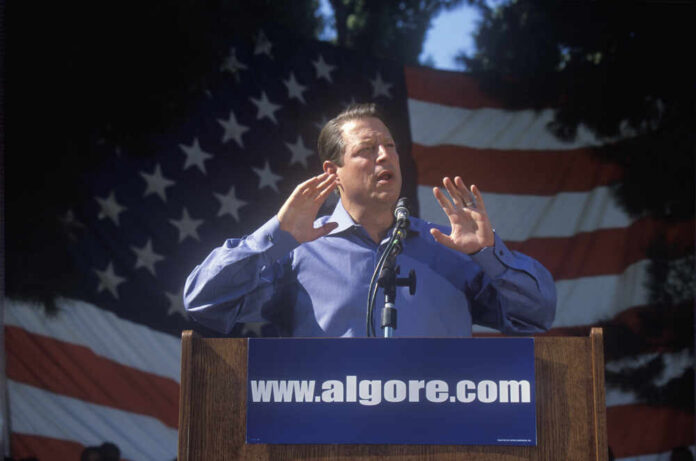
Al Gore says the world stands at the edge of danger and a breakthrough—at the very same time.
Story Snapshot
- Gore told the Associated Press that victory for a clean Earth is within reach.
- He warned climate risks remain “grave,” even as momentum builds.
- He pointed to 2026 as a possible positive tipping point for clean energy trends.
- His long record argues solutions exist if leaders act quickly and decisively.
Gore’s case: peril, possibility, and a near-term tipping point
Al Gore used New York Climate Week to deliver a sharp two-part message. He said the world faces grave climate danger. He also said a clean Earth is still within reach if people act now. He told the Associated Press that 2026 could be marked as the start of a “positive tipping point.” He framed this not as wishful thinking but as a result of market and policy shifts already underway. He summed it up plainly: “The answer is in our hands”.
Gore’s optimism did not erase his warning. He noted that the window to avoid worse harm is tight. He also said the planet can still win this fight. He described momentum across clean power, technology, and policy. He argued these gains can snowball, just as past changes did in other industries. He pushed the idea that fast action by governments and companies can lock in a safer course while there is still time.
What’s different now: signals from energy and policy
Gore pointed to mounting signs that clean energy is breaking through. Global trackers report that renewable power passed key marks in 2025 and 2026. Multiple analyses show renewables outpacing coal in global electricity and meeting most growth in demand. These are system-level signals, not one-off wins. Gore’s case fits that picture: a point where costs fall, adoption spreads, and change feeds on itself—if leaders stay the course.
Former VP Al Gore: A clean Earth is within world’s grasp even as climate dangers accelerate: https://t.co/qj3jZvyX8y
— The Virginian-Pilot (@virginianpilot) September 26, 2026
That frame echoes Gore’s long record. In his Nobel Lecture, he argued the world has the tools to solve the crisis if leaders act “boldly, decisively and quickly.” He called for policies that price carbon and speed clean investment. He accepted that not all harms can be avoided, yet insisted much worse can still be prevented. His current push leans on the same idea: unite markets, policy, and civic will, then scale.
Grave risks, firm choices, and the conservative test
Gore’s comments carry a hard edge: delay raises costs and danger. That claim tracks with scientific guidance that warming must peak soon to reduce tipping risks in natural systems. The logic aligns with common sense and core conservative values. Protect home and country. Keep costs predictable. Build energy that is reliable, clean, and made close to home. A steady plan now beats disaster bills later, which hit families and small businesses first.
Former VP Al Gore: A clean Earth is within world's grasp even as climate dangers accelerate https://t.co/q69vVdZ3iP
— #CaliBernication (@brooklynnygirl) September 28, 2026
Critics often ask for proof that a single year can mark a “tipping point.” Gore did not offer a lab-style threshold. He argued that 2026 could be the moment historians see a clear bend in the curve—where clean power gains turn into durable market rule. The caveat stands: forecasts are not outcomes. Still, the claim rests on public data trends and a practical bet that policy and industry can lock them in.
What to watch next: signals that confirm the bend
Three markers will test Gore’s bet. First, global emissions must peak and start a steady fall. Second, clean capacity needs to meet not only growth in demand but replace fossil generation at scale. Third, capital must keep flowing into clean grids, storage, and firm power. If those hold, the “positive tipping point” label will fit the record, not just the rhetoric. Gore’s bottom line remains blunt: the tools exist; the choice is ours.
Sources:
apnews.com, usnews.com, motherjones.com, nobelprize.org