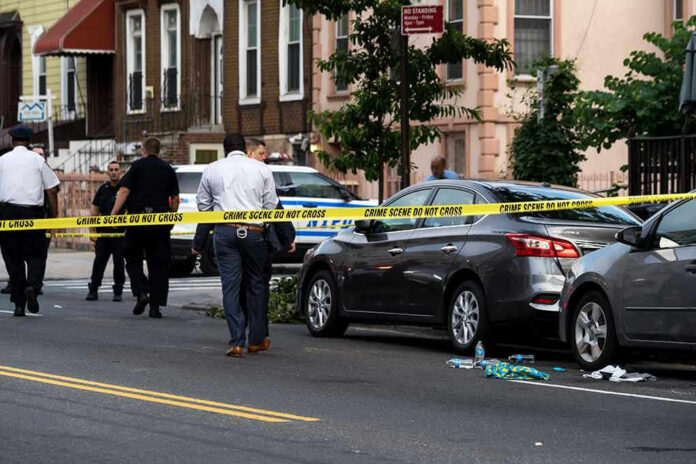
Police say a single North Philadelphia house holds more than one million digital files tied to missing women and scenes that look like death.
Story Snapshot
- Detectives seized over 600,000 images, 70,000 videos, and thousands of pages from the Chew Avenue home.
- Footage on an early hard drive appeared to show two named missing women dead inside the house, police said.
- Investigators identified 58 people across the digital cache so far, with review work still underway.
- No human remains were found on site despite months of searching, officials said.
Police map a digital-first case from a single address
Philadelphia Police described a vast digital trove linked to a house on West Chew Avenue. Inspectors said detectives collected more than 600,000 images, 70,000 videos, and over 10,000 pages of writings and drawings from devices in the home.
According to officials and local reporting, the haul came from cameras, computers, hard drives, phones, flash drives, and digital video recorders. The scale alone put the case in a modern category. Police now chase timelines built from pixels, tags, and file logs before any body turns up.
Investigators said key videos and photos were shot inside the Chew Avenue home. Police briefings tied scenes in the files to rooms and fixtures found there.
On an early hard drive, detectives reported images and video where two missing women, named as Maribel Fresses and Gabrielle Amarando, appeared dead.
That link, officials said, came from content and data that placed the women in the home and in distress. Police described the material as graphic and dark.
Names, faces, and a count that keeps growing
Police said the review identified 58 people across the digital files. Some images show women injured, unconscious, or possibly lifeless. That description came from multiple briefings and matched reports across outlets that attended them. Detectives said the dates on the files go back years.
That range can widen the search for witnesses, phone records, and location data. It also increases the odds of overlap with old missing-person cases that did not have a clear suspect at the time.
Woman recalls chilling encounter with vile pornographer, son inside Philly house of horrors linked to 7 missing women https://t.co/QOTMP52pZM pic.twitter.com/riIo36cqkc
— New York Post (@nypost) September 28, 2026
Officials said a computer forensics team began formal review in early August. The Federal Bureau of Investigation (FBI) joined the analysis. At later briefings, police said they had reviewed only a portion and that the team continued to process files and match identities.
That rhythm tracks how major cases move now. Review teams sift terabytes. They tag faces and rooms. They build timelines and then test them against calls, texts, and bank data. That steady work feeds search warrants for more devices and accounts.
No bodies on site, but the evidence still points inward
Police said they did not find human remains at the property. That point matters. But it does not end the case. Detectives said the interior matched scenes in the videos and photos. They also said the known missing women tie to that address.
Multiple outlets reported that police believe at least five of the missing women appear dead in recovered media, based on the images alone. One briefing added that some women were posed and showed trauma.
🚨 House of Horrors Philadelphia – A new search warrant for the home on W Chew Ave has been executed.
The FBI expects to be at the home for about a week.
There will be impacts to the neighborhood including road closures.
Stay tuned ! pic.twitter.com/yOptVX7uxC— ⚫️ queenvictoria (@QVic619) September 28, 2026
Police also named the devices and their sources. They listed cameras, computers, hard drives, phones, flash drives, and digital video recorders seized at the home. That range helps on a basic chain-of-custody test.
One scene seen on a camera, copied to a computer, then stored on a drive, creates a path. That path can show who held what, and when. That is how a digital case grows into charges that a court can hear and a jury can grasp.
What moves next as review deepens
Detectives said the next phase focuses on three tasks. First, finish the forensic review. Second, confirm the identities of people in the files, and re-interview those already known. Third, align file dates and movement data, such as vehicle and phone records, with missing-person timelines.
Officials said the review had reached only part of the cache, and that more links may appear as they process the rest. Several families told local media they want a full accounting soon.
This case also shows how digital evidence now drives violent-crime work. Police and the FBI often must triage huge volumes fast to save leads. That load can strain labs and delay answers, but it can also surface truth that a shovel never would.
Here, the files turned a quiet rowhouse into a focal point for seven women gone over a decade. The moral test is simple and aligns with common sense. Find every woman. Prove what happened. And do it by the book, so justice sticks.
Sources:
abcnews.com, cbsnews.com, nbcphiladelphia.com, nbcnews.com, abc7ny.com, whyy.org, 6abc.com, bbc.co.uk, fox29.com, crbcnews.com, fox5atlanta.com, newsweek.com