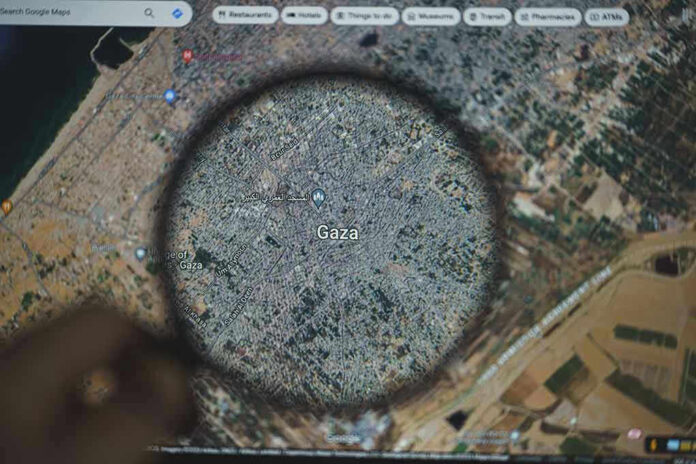
President Donald Trump’s blunt call for Israel to “finish off” Hamas has left liberals reeling as the Gaza conflict enters yet another deadly phase.
With the president’s words, American policy is now more unapologetically hardline than ever.
At a Glance
- Trump openly supports Israel’s military campaign to annihilate Hamas, dismissing international criticism.
- Ceasefire efforts collapsed after Hamas rejected a new US-backed proposal in July 2025, reigniting violence in Gaza.
- Trump has proposed relocating Gaza’s population and reconstructing the territory under US management, a plan rejected by the region.
- International moves to recognize Palestinian statehood have been dismissed as symbolic and irrelevant by the Trump administration.
Trump Backs Israel’s Relentless Campaign Against Hamas
President Trump, never one to mince words, has made it clear: when it comes to the war between Israel and Hamas, there is no room for half-measures. Responding to Hamas’s rejection of a new US-brokered ceasefire, Trump declared that Israel should “finish off” Hamas once and for all.
His follow-up, “I think they want to die,” has ricocheted through international media and diplomatic circles, sending a message that under this administration, American support for Israel’s military campaign is not just unwavering, but downright unapologetic.
His stance sharply contrasts the endless hand-wringing and hedging that typified the Biden years, when every Israeli action sparked a chorus of finger-wagging from the White House, the UN, and the European Union.
Trump’s clarity, whether you love it or hate it, cuts through the fog of political correctness that has too long clouded US foreign policy.
Trump’s rhetoric followed the rapid breakdown of a ceasefire that had been painstakingly negotiated and announced in January 2025. The agreement, brokered by the US, Qatar, and Egypt, was supposed to bring an end to 15 months of carnage that began with Hamas’s October 7, 2023, terror attack, the deadliest day in Israel’s history.
Instead, the ceasefire barely lasted two months. By March, Israel had resumed its bombing campaign, blaming Hamas for repeated violations. And despite another push for a truce in July, Hamas’s outright rejection triggered Trump’s call for decisive military action.
For those sick and tired of “diplomatic cycles” that only prolong the suffering and embolden terrorists, Trump’s position is a welcome return to common sense: you do not negotiate with those who openly call for your destruction.
International Pushback and the “Symbolic” Recognition of Palestine
As Israel’s campaign resumed, the usual suspects in Europe rushed to signal their virtue. French President Emmanuel Macron led the charge to “recognize” a Palestinian state, purely symbolic and utterly divorced from the realities on the ground. Trump dismissed the gesture in typical fashion, saying it “doesn’t carry any weight.”
For years, American foreign policy has been hijacked by European elites and UN bureaucrats who believe that signing declarations and holding summits is a substitute for real action.
Trump’s approach is refreshingly different: no more bowing to international pressure, no more apologies for standing with the only democracy in the Middle East.
The administration’s focus is on results, not optics. And right now, that means supporting Israel’s right to eliminate a terrorist threat at its border, not caving to the demands of countries that haven’t faced a rocket attack in decades.
Meanwhile, the Trump administration’s dismissal of international posturing has ruffled more than a few feathers in the diplomatic world. But for conservative Americans, the message is clear: US foreign policy is once again being set in Washington, not Brussels or Paris.
The days of letting foreign leaders dictate terms to America are over. As for the UN and its endless stream of resolutions and condemnations, they have been reduced to background noise in the new White House calculus.
Humanitarian Crisis and Trump’s Controversial Gaza Proposal
Gaza’s suffering is real and undeniable. After nearly two years of war, more than 52,000 people have been reported killed, the vast majority Palestinians. Gaza’s infrastructure is in shambles, its population displaced and desperate.
In response, Trump has floated a plan that has set off alarm bells across the region: relocate Gaza’s population and rebuild the territory under US management.
This proposal, dismissed outright by neighboring Arab countries, would upend decades of conventional thinking about the conflict. Critics claim it violates international law and is logistically impossible.
But others see it as a radical attempt to break the cycle of violence and misery that has trapped Gaza’s civilians between Hamas rockets and Israeli airstrikes.
Whether or not the plan ever gets off the ground, it speaks to a larger truth: the status quo is unsustainable, and American leadership is finally willing to challenge the failed orthodoxy of the past.
For Gazans, the fighting has brought only loss of life, land, and hope. For Israelis, the threat of rockets and cross-border raids remains ever-present. Each new round of violence further entrenches the divisions and delays any chance at a real peace.
Trump’s willingness to think outside the diplomatic box may anger the professional compassion industry, but for those who believe in real solutions over empty slogans, it’s at least an attempt to shift the paradigm.
Regional Fallout and the Future of US Policy
The risks of wider conflict remain disturbingly high. Hezbollah, Iran, and a laundry list of regional bad actors continue to exploit the chaos in Gaza. Trump’s critics warn that doubling down on military action could trigger a broader war.
Supporters, meanwhile, argue that weakness and appeasement got us here in the first place. What is clear is that the United States has returned to a position of unapologetic strength; one where American interests and allies come first, and the days of dithering and deference are over.
As the world watches Israel push to “finish the job,” the humanitarian crisis in Gaza will only intensify. But for the first time in years, US policy is no longer paralyzed by fear of global condemnation. Whether this new approach will bring resolution or further escalation remains to be seen.
One thing is certain: under Trump, the era of endless process and toothless diplomacy is over, replaced by a foreign policy that prizes clarity, strength, and results.