
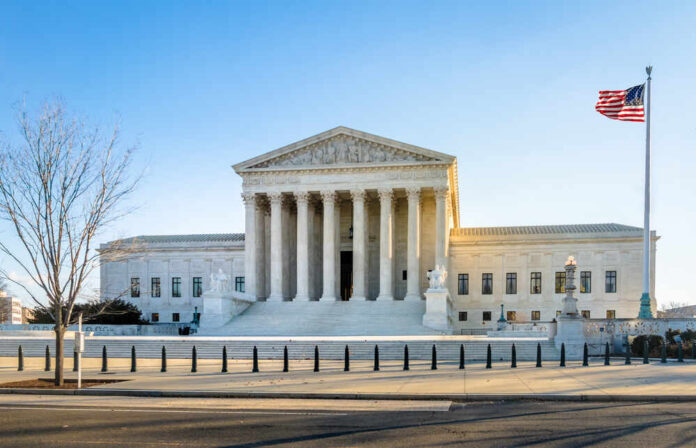
The Supreme Court cleared the way for states to check voter rolls against a revamped federal citizenship database before November, and that changes the election math now.
Story Snapshot
- The Court paused a lower-court block, letting the administration’s tool run for now.
- States may query the Department of Homeland Security’s SAVE system to verify citizenship.
- Critics warn of errors, privacy risks, and harm to naturalized voters.
- The decision is temporary while appeals continue; the stakes are immediate.
What the Court Allowed and Why It Matters
The Supreme Court stayed a June order from a federal district judge that had blocked the modified Systematic Alien Verification for Entitlements program. That stay lets the Department of Homeland Security support state voter checks while the case proceeds.
The Court’s order does not end the lawsuit. It restores the status quo the administration sought before the midterms begin in earnest. The ruling signals concern about disrupting election operations this close to voting.
BREAKING: The Supreme Court allowed the Trump administration to resume its expanded voter citizenship verification program, which lets states use Social Security records to check voters' citizenship. Justices Sotomayor, Kagan, and Jackson dissented. pic.twitter.com/jEhmk13Om2
— SCOTUS Wire (@scotus_wire) September 25, 2026
The order gives President Trump a short-term win on noncitizen voting. States can now send bulk queries from their voter lists to the federal system and receive citizenship status matches.
Supporters call this basic list maintenance and say it protects the weight of each lawful vote. They argue states have a duty to keep rolls clean and that federal data, used carefully, helps do that job faster and better.
How the SAVE Tool Was Revamped
The Department of Homeland Security linked its long-running benefits-status database to more records, including Social Security data, to widen the search for citizenship information. The goal was to help states confirm who is a citizen and who is not on their rolls.
The tool expanded from case-by-case checks to large list matching. That shift made it potent. It also raised warnings from privacy groups and voting advocates who see a risk when old data is used at scale.
News accounts report the Court’s majority pointed to federal law that allows information sharing with states for lawful purposes, including citizenship verification for elections.
Outlets summarizing the order said the majority cited a 1996 statute that lets the Department of Homeland Security obtain and share status data with government agencies.
That framing tracks with a common-sense view: when states ask for citizenship data to enforce their own laws, the federal government should answer.
What Opponents Argue Could Go Wrong
Opponents say the database is not built for elections, can be out of date, and can mislabel naturalized citizens as noncitizens. They also argue the expansion broke privacy and procedure laws.
The district judge who first blocked the tool said it likely violated the Privacy Act, the Social Security Act, and the Administrative Procedure Act, and could cause lawful voters to get flagged or even dropped. That ruling is on hold, but its findings still loom over the case.
📷📷Supreme Court lets Trump administration use revamped federal voter eligibility database for nowThe Supreme Court on Friday lifted restrictions on a controversial federal voter database before November’s election… pic.twitter.com/Y0o63TvZ6Q
— joe t (@jtinaglia) September 28, 2026
Justice Ketanji Brown Jackson wrote in dissent that the government had not shown a need to block the lower-court order and warned that harms to lawful voters could continue.
She stressed the burden that wrong flags can place on new citizens, who may face confusion and extra steps to stay on the rolls. That view spotlights a real risk: any large data match must be precise, transparent, and paired with clear notice and an easy cure for errors.
The Case for Guardrails, Not Gridlock
Election integrity and voter access are not rivals. Both are duties. The Supreme Court’s stay respects the states’ role in keeping accurate rolls and the federal role in answering lawful data requests. That aligns with federalism and rule-of-law values.
But prudence demands safeguards. States should use the tool to generate leads, not automatic removals. They should confirm matches with direct outreach and give voters a simple path to fix records before any change is made.
Good policy here looks like tight matching rules, recent data, bilingual notices, and a “no one is removed based on a single database” standard. That approach protects legal voters, including new citizens, while making it harder for noncitizens to stay on rolls.
It also reduces courtroom drama. The Court’s temporary order is not a blank check. It is a test: can states use federal data with care, document every step, and prove that integrity and access both win? We will see it play out fast.
What to Watch Before November
Watch whether states adopt written protocols that bar removals without multiple verifications. Watch whether they time any actions to avoid last-minute confusion. Track error rates, notice letters, and cure windows. If states show discipline, confidence rises.
If sloppy matches drive headlines, pressure for another shutdown of the tool will grow. The Supreme Court opened the door for now. Voters will judge how leaders walk through it, and the appeals court will judge the law soon after.
Sources:
law.cornell.edu, pbs.org, apnews.com, npr.org, bbc.com, cnn.com, cbsnews.com